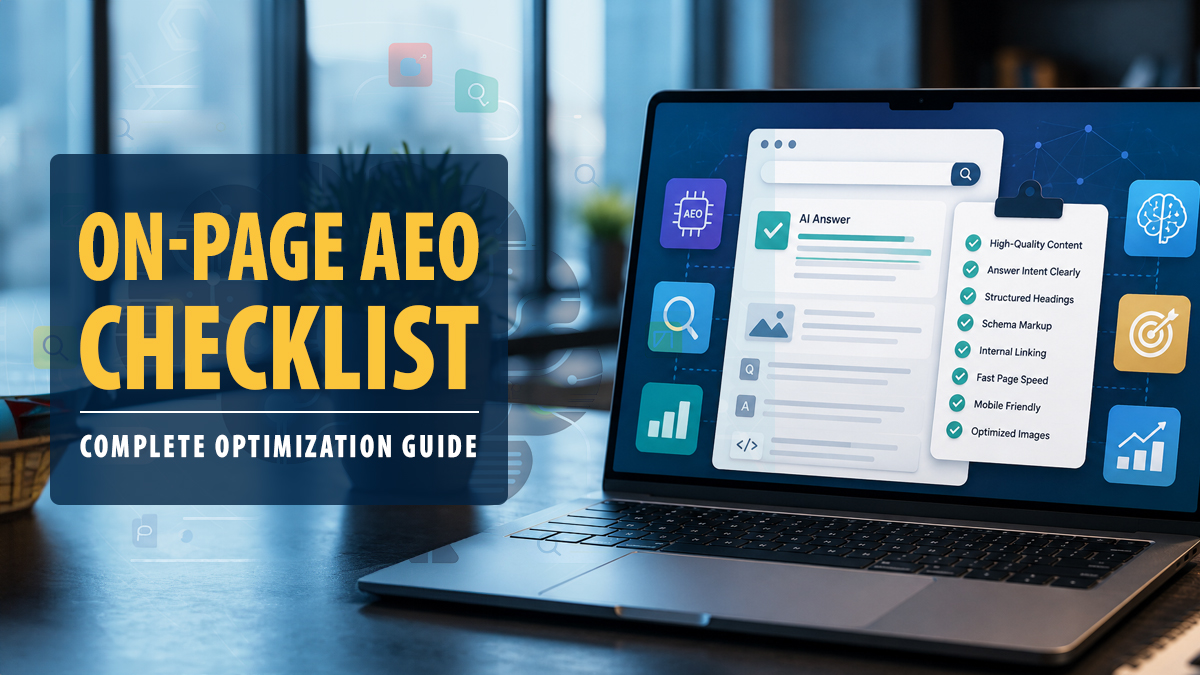
With the increasing availability of AI-powered search experiences, it is important for business organizations to optimize their websites for purposes other than SEO. Answer Engine Optimization (AEO) refers to the process through which businesses create content that AI engines can easily analyze, extract and present in the form of answers to queries made by users.
Key takeaways:
- On-page AEO is an extension of conventional SEO where on-page content is optimized for an AI engine that produces direct answers instead of ranking websites.
- It is important to use both on-page and off-page optimization techniques, whereby on-page optimizes the accessibility of the content and off-page enhances credibility and authority.
- The AI search engine places much emphasis on semantics by analyzing entities, relationships, and contexts, unlike the keyword-only SEO technique.
- Answer the questions posed by the user straight away and at the top. Important details should be provided right after the headings for easy extraction by AI.
- Structure the content to be easily read by AI through the use of headings, bullets, numbers, tables, and sectioned content.
- Ensure original experience-driven content such as proprietary research, case studies, and insights from experts are used since AI search engines are likely to refer to them.
- Consistently optimize entities by using the same language across the pages, and creating relationships between topics through linking.
- Make bots crawl the website based on the latest robots.txt, XML sitemaps, and HTML data.
- Build authority through the use of the E-E-A-T framework, which entails experts, authoritativeness, expertise, trustworthiness, and sources.
- Keep track of the performance of AEO through the following AI factors: brand mentions, citations, brand sentiment, share of voice, and SEO.
- SEO and AEO should be used in tandem for a successful strategy, since both are related.
Though technical optimization holds great importance, on-page AEO techniques are crucial in ensuring improved visibility in AI-powered search engines. Such optimization techniques include developing quality content, having proper heading tags, directly answering the question of the users, metadata optimization, internal linking, and readability improvement.
All these strategies play a crucial part in enabling AI systems to comprehend the meaning of a particular page, its relevancy, and whether it provides authoritative information. On-page AEO checklist not only increase the likelihood of being visible in the answers provided by AI engines but also improve the user experience.
If you want to improve answer engine visibility and earn more mentions across AI-powered search platforms, partnering with an AI SEO service provider can help optimize your content for stronger AI search visibility and measurable business growth. Following an On-Page AEO Checklist alongside lead generation SEO can improve content discoverability while helping attract prospects with stronger conversion intent.
| On-Page AEO Element | What to Check | Priority |
| Direct answers | Important questions receive concise, immediate answers | High |
| Heading structure | H1, H2, and H3 tags create a clear hierarchy | High |
| Content formatting | Use short paragraphs, bullets, lists, and tables | High |
| Entity clarity | Brands, people, products, and concepts are clearly identified | High |
| Schema markup | Relevant structured data accurately reflects page content | High |
| Internal links | Related topics are connected with descriptive anchor text | Medium |
| AI crawler access | Relevant search and retrieval bots can access important content | High |
| Author signals | Author expertise and credentials are clearly presented | Medium |
| Content freshness | Facts, statistics, links, and examples are current | Medium |
| AI visibility | Citations, mentions, sentiment, and share of voice are monitored | High |
What is On-Page AEO?
On-page AEO involves the strategic formatting, structuring, and optimization of webpage content to ensure that LLMs and answer engines can effectively crawl, extract, comprehend, and reference your brand in their generated replies.
Consider it the organic progression of on-page SEO. Traditional on-page optimization aims to rank URLs among a list of blue links by utilizing keyword density and backlinks, whereas on-page AEO prioritizes delivering clear, concise, and well-structured answers that AI models rely on as primary sources.
Therefore, if you possess a solid understanding of SEO, you’re already headed in the correct direction. Much of the foundation for AEO aligns with the conventional optimization strategies you have employed. AEO highlights the signals and criteria that influence an AI model’s choice of your content instead of that of a competitor.
On-Page Optimization versus Off-Page Optimization in 2026
To completely understand on-page AEO tactics, you must recognize the connection between on-page and off-page optimization regarding AI search. Both are essential, yet they fulfill distinct roles in the AI discovery ecosystem.
On-page optimization involves all the modifications and enhancements you implement directly on your site to boost visibility. This encompasses your content organization, entity definition, technical performance, internal links, schema tags, and loading speed. It is the level of search visibility that you can fully control.
Off-page optimization involves efforts made beyond your website to influence your authority and trust indicators. In conventional SEO, this primarily involved acquiring backlinks. In the realm of AEO, off-page optimization is significantly more intricate.
AI answer engines place significantly greater emphasis on earned media links, unlinked brand mentions, third-party citations, and your activity on platforms such as Reddit, Quora, or G2 compared to traditional search algorithms.
An AI engine will not reference a well-optimized page if the brand lacks a solid reputation for off-page trust and authority. Here’s a brief explanation of how those priorities vary in the AI age.
| Area | On-Page AEO | Off-Page AEO |
| Main focus | Content accessibility and understanding | Brand authority and external credibility |
| Where it happens | On your website | Across third-party platforms |
| Content | Answers, headings, tables, FAQs | External references and discussions |
| Technical factors | Schema, rendering, crawlability | Limited direct control |
| Entity signals | Consistent names and descriptions | Consistent third-party brand references |
| Authority signals | Expert authors, sources, original research | Media mentions, reviews, citations, backlinks |
| Brand control | High | Lower |
| Primary goal | Make information easy for AI to retrieve | Give AI independent reasons to trust the brand |
Priorities for on-page AEO:
- Content segmentation and arrangement
- Entity definition and coherence
- Implementation of schema and structured data
- Immediate response to user inquiries
- Accessibility and rendering for AI crawlers
Priorities for off-page AEO:
- Unlinked brand references in reputable publications
- Favorable sentiment in external evaluations
- Engagement in communities centered around user-generated content
- Digital public relations and professional insights in industry summaries
- Classic premium backlinks
You require both to achieve success. However, when you correctly optimize the on-page elements, it becomes much simpler for AI systems to link your off-page credibility with your on-page responses.
Why Does On-Page Optimization Matter for AI Search in 2026?
On-page optimization is the sole aspect of AI search where brands possess total authority over the dialogue. You can’t compel a third-party publisher to acknowledge your brand; however, you can manage how your technical setup and content organization present data to an AI crawler.
AI engines process and segment pages in a distinct manner compared to conventional crawlers. Conventional search engines look for specific keywords, evaluate the backlink profile, and determine the page’s ranking according to its relevance and authority.
AI models analyze your content into semantic components, identifying entities and connections to address intricate, multi-faceted inquiries. This establishes a wholly different pattern of traffic and visibility. Users aren’t navigating through several search results to compile their own answers. Google recommends focusing on unique, valuable content, strong page experience, crawlability, and accurate structured data to improve performance across its AI-powered Search experiences.
The synthesis is done by the AI for them. If your on-page content isn’t structured in a manner that the AI can effectively extract and reference, you won’t show up in the output, rendering that content virtually invisible.
AI Understands Your Content Better
Through on-page optimization, AI search engines gain an understanding of the topic of your page. Good heading structure, title, appropriate keywords, and overall organization of your content allow the AI algorithm to detect the topic of the page and associate it with the user’s intent.
Moreover, good formatting makes it possible for the AI to correctly summarize your content and use it in responses generated during the process of searching. It is much more probable that the page that has high semantic relevance and correct organization will be considered authoritative by the AI algorithms.
- Includes descriptive titles, headings, and subheadings which clearly indicate the topic of your page to AI search systems.
- Helps AI models identify the purpose, context, and intent of your content for better search relevance.
- Establishes semantic relationships between keywords, topics, and additional information, allowing content to be understood easily.
- Increases the probability of being summarized, cited, or recommended by AI search tools in responses.
Improves User Experience and Engagement
AI search favors content which offers a good user experience. Page optimization creates a user-friendly environment by making pages more readable using short paragraphs, headings, pictures, and easy navigation. Fast loading speeds and responsive design help in minimizing user frustration.
Longer stays on the site reflect higher engagement and suggest that content is relevant. Positive engagements mean that users find the content helpful. Through this technique, websites will not only be successful in addressing user concerns but also increase their presence in search results powered by AI.
- Creates an environment where users find it easy to process information because of organized contents with well-written headings.
- Helps load very fast and is responsive to provide users with a better browsing experience.
- Visitors stay longer because of easy navigation and good page designs.
- Helps in creating engagement signals that may make the AI search system trust your content.
Increases Content Relevance and Accuracy
AI search engines determine if content provides an answer to the user’s question. The on-page optimization technique makes sure that pages have natural keyword usage, offer full explanations, and stay topic consistent. Content with proper structure and accurate information will help AI algorithms interpret the context correctly.
Updating pages regularly will keep them updated, which is an advantage for AI-based search engines that prefer trustworthy sources. When content matches user search intent and provides necessary information in a proper way, it becomes more likely to be included in AI-based search results.
- Matches user search intent by providing answers to their questions clearly and comprehensively.
- Includes natural keywords in content to help AI determine its topic.
- Creates topical authority through internal linking, related content, and properly structured information.
- Provides up-to-date and accurate information, which increases the likelihood of being trusted by AI-based search engines.
Enhances Visibility Through Structured Content
Structured content is useful for AI-powered search tools since it enables them to extract vital pieces of information faster. Optimization on-page involves such measures as heading tags, bullet points, tables, FAQs, and schema markup when needed.
Such formatting not only makes information more readable and easily searchable but also increases the chances of having AI systems use relevant pieces of information in summaries or answer boxes.
The logical arrangement of information also assists people in seeing things in order. The more the importance of structured information is realized by AI algorithms, the more chances there are for websites to get ahead in terms of visibility.
- Involves the use of headings, bullet points, tables, and FAQs in order to structure information for AI systems.
- Enables AI systems to extract key pieces of information for summaries, snippets, and conversational responses.
- Makes information more readable for both users and AI algorithms in a logical sequence.
- Increases chances of having better visibility due to AI-generated answers and snippets.
Builds Trust and Authority
AI engine algorithms give preference to content that is reliable, trustworthy, and authoritative. These can be achieved by on-page optimization such as consistency of the data presented, citing reliable sources where needed, and professional presentation of the content.
Good quality content with proven expertise is more likely to get backlinks and recognition from the audience and AI search engines. Eventually, this will increase the probability of the site being recommended, summarized, or referenced by AI-powered search engines.
- Demonstrates expertise with accurate and up-to-date information on the website.
- Credibility is created through professional presentation of the content and internal links within the website.
- Encourages users to believe in the content and visit the site repeatedly.
- Increases the probability of the site being recognized as a trustworthy and authoritative source of information.
The Connection Between On-Page AEO and On-Page SEO in 2026
Before we explore the detailed on-page AEO techniques, we must discuss the overlap. On-page AEO does not replace on-page SEO. It’s expanding on it. The essential techniques of keyword optimization, header arrangement, internal links, content richness, and author indicators remain the cornerstone of online visibility.
By optimizing a page for particular target keywords or subject areas, you facilitate Google in parsing and comprehending your content, while also instructing the AI model on the topics and entities your page encompasses. The primary distinction is found in purpose and retrieval.
On-page SEO frequently emphasizes retaining a user on the page with detailed stories and comprehensive background. On-page AEO aims to provide quick, direct responses as the objective of an answer engine is to deliver the needed answer to a user promptly, rather than offering extensive context to set up their intended topic.
Strategies for On-Page AEO for Content
Content serves as the fuel for AI response systems. However, not all content holds the same value in the perspective of an LLM. To receive citations, your content needs to be organized in a way that machines can understand.
Create Answerable Content
If your content doesn’t directly respond to the inquiries your intended audience is posing, it won’t be referenced. Clear and straightforward. Writing for answerability involves prioritizing your most important information.
For instance, if you’re employed by a healthcare provider and you’re developing content that outlines the distinctions between an FSA and an HSA, you shouldn’t conceal the table detailing their differences in the concluding paragraph.
It’s important to present that information upfront and make sure it follows closely after the corresponding header text. You aim to give a clear, conclusive response that an AI model can easily reference without sifting through numerous words of unnecessary dialogue.
A crucial aspect of answerability is to employ question-oriented headings that reflect the inquiries users input into AI prompts. When creating a guide on website migrations, include an H2 such as How long does a website migration take? and directly follow it with a bold, straightforward response.
Ultimately, formatting significantly impacts how easily LLMs can interpret your content. Definition blocks, key takeaway boxes, bulleted summaries, and similar formats in your articles indicate that you have transformed complex information into an easily understandable format, which is precisely what the AI aims to achieve for the end user. It allows LLMs to easily incorporate your content verbatim into their responses.
Organize and Segment Information for AI Retrieval
Content chunking involves dividing information into small, separate, and logically structured segments that can be comprehended without depending on the surrounding text. Although traditional SEO appreciates detailed, lengthy content, AI models analyze information in smaller segments.
If your page appears as an enormous block of text lacking distinct structural divisions, the AI will find it difficult to pinpoint the most pertinent information. To enhance chunking, brands ought to:
- Depend significantly on HTML structure
- Utilize bullet points to deconstruct processes or characteristics
- Use step-by-step guide with numbered lists
- Utilize HTML tables to display data, comparisons, and specifications—AI models are proficient at interpreting and extracting information from well-structured tables
An effective method to confirm that you are chunking your content is to aim for each section to be able to exist independently. Should an AI engine pull a singular paragraph from your page for an AI Overview, that paragraph must be coherent on its own, independent of the surrounding context.
Therefore, it is crucial to clearly identify the specific entity or subject you are discussing and refrain from using unclear pronouns such as this process or these tools at the start of a section.
Focus on Uniqueness, Exclusive Information, and Original Sources
AI answer engines do not cite or reference generic listicles or recycled industry advice. LLMs have already been trained on vast amounts of general information; they certainly do not require another broad definition of digital marketing.
They require your website for what they cannot produce on their own: unique information and personal experience. Generating original content derived from exclusive data is the best method to build credibility and compel AI models to reference you.
When you carry out an original survey, examine internal customer data, or release a proprietary benchmark report, you establish yourself as the main source for that information. When a user requests an AI engine for statistics concerning your industry, the AI must retrieve your original data and reference your brand.
Emphasize quotations from specialists, in-depth case analyses, and exclusive studies. When your web team addresses a complicated technical problem, record the precise procedure using actual data points. This degree of detail and uniqueness is something AI cannot reproduce.
Emphasize Clarity and Consistency of Entities
AI models don’t process keywords like conventional search algorithms. They conceptualize in terms of entities. An entity is a specific, clearly defined concept, individual, organization, or object that can be uniquely recognized and associated with other entities.
To enhance AEO, it’s essential to concentrate on the clarity of entities. This implies labeling items consistently throughout all your web pages. If you label your product as enterprise marketing software on the homepage, avoid referring to it as a digital optimization tool on the pricing page. Choose a main entity and adhere to it.
Consider it as an effort to ensure your content is as clear and coherent as it can be. Define jargon and acronyms from the industry on first use rather than assuming an AI will inherently comprehend and interpret them.
Particularly in rapidly changing sectors such as AI search, the AI may not be entirely aware of which acronym is currently the most prevalent. Ultimately, it’s essential to view your internal linking approach as a means to strengthen the connections between entities.
For example, when you connect a blog entry to a product page, utilize precise anchor text that clearly identifies the entity you are referencing. This assists the AI in creating a semantic map of your site and comprehending how your various subjects are interconnected.
Strategies for On-Page AEO for Technical Health
You might create the most brilliant, ready-to-answer content globally, but if AI bots cannot access or display it, you won’t be referenced, and at worst, LLMs may start perceiving your website and brand as untrustworthy. Technical AEO is quite akin to technical SEO, but it emphasizes machine readability much more.
Integrate Schema and Structured Data for AI Systems
Schema markup serves as the common language for search and answer engines. It converts your content into a well-structured data format that machines can quickly interpret. For AEO, adopting JSON-LD schema is mandatory.
Traditional search engines employ schema to create rich snippets, whereas AI models utilize schema to reliably extract information and comprehend the context of your content. You’re essentially providing the AI with an organized database of your web page. Focus on the schema types that are most significant for AEO extraction:
Article Schema: Defines the writer, date of publication, and main subject.
FAQPage Schema: Directly associates questions with their answers, closely matching the behavior of AI prompts.
HowTo Schema: Divides procedures into coherent steps for straightforward retrieval.
Product Schema: Provides AI systems with precise pricing, availability, and specification information.
Organization Schema: Strengthens your brand identity and links your social accounts.
Person Schema: Defines the qualifications and expertise of your writers.
Breadcrumb Schema: Assists AI models in comprehending website structure and content organization.
After you implement it, you must also routinely audit your schema to confirm it correctly represents the page content. A misaligned schema will cause bots to misinterpret your content, quickly resulting in a loss of trust with both search and answer engines.
Enhance Rendering for AI Crawlers
AI crawlers navigate and render the web differently than a user’s browser does when loading a page. This poses a significant technical obstacle for contemporary websites developed using intricate JavaScript frameworks.
Numerous AI crawlers, such as those employed by prominent LLMs, lack efficient JavaScript execution, and some cannot execute it whatsoever, focusing solely on the raw HTML source code. If your content, navigation, or links depend on client-side JavaScript for rendering, that content is essentially hidden from these AI bots.
If an AI crawler is unable to access your content, it cannot reference it. It’s essential to deliver your crucial content through server-side rendering (SSR) or dynamic rendering. When a bot accesses your page, the server must return a complete HTML document that includes all the text, links, and structured information.
You can utilize log file analysis tools, such as AI Bot Crawler Analysis in Conductor Monitoring, to observe precisely how AI bots are engaging with your pages. If they are accessing pages but unable to retrieve the content, you probably face a rendering problem that requires urgent attention from your IT or web development team.
Optimize Core Web Vitals, Website Speed, and Mobile Performance
Site speed and mobile optimization continue to be essential elements for on-page AEO, similar to their importance in SEO. Although AI bots concentrate on data extraction, the platforms supporting these bots continue to prioritize user experience.
For instance, Google’s AI Overviews are fully integrated into the essential search algorithm, indicating that Core Web Vitals continue to determine overall visibility.
Make sure your pages load rapidly, eliminate render-blocking resources, and offer a smooth mobile experience. AI crawlers function within crawl budgets similar to conventional search bots. If your server is slow to respond, the bot will give up on the crawl, resulting in your latest content remaining unnoticed.
Strategies for On-Page AEO for Crawlability
Technical health guarantees your site functions properly; crawlability ensures AI bots are permitted entry through the front door. An intentional and proactive approach is required to manage bot access and direct them to your key content.
Guarantee Accessibility for AI Bots
The rise of generative AI has brought forth numerous new web crawlers. Overseeing your robots.txt file goes beyond just Googlebot and Bingbot now.
Brands must now take an active role in managing access for bots that collect LLM data. Most leading AI companies run several unique bots, each serving a specific function. Only OpenAI runs three:
- GPTBot scans the internet to collect information for training upcoming models.
- OAI-SearchBot explores to reveal content within ChatGPT search outcomes.
- ChatGPT-User retrieves certain URLs instantly when a user or agent accesses a page in the course of a discussion.
For instance, you could restrict GPTBot to prevent your content from being included in training data, while permitting OAI-SearchBot and ChatGPT-User to ensure your brand remains visible in ChatGPT responses and is accessible when needed.
OpenAI states that websites need to allow OAI-SearchBot access if they want their content to be eligible for inclusion in ChatGPT Search.
This identical pattern of training versus search versus user is consistent among providers. The primary AI bots you should consider are:
- OpenAI: GPTBot (training), OAI-SearchBot (search), ChatGPT-User (user/agent retrieval)
- Anthropic: ClaudeBot (training), Claude-SearchBot (search), Claude-User (agent/user retrieval)
- Google: Google-Extended (AI training; distinct from Googlebot, which manages search)
- Perplexity: PerplexityBot (indexing), Perplexity-User (user retrieval)
- Apple: Applebot-Extended (AI training; distinct from Applebot)
- Meta: Meta-ExternalAgent
- Common Crawl: CCBot (data utilized for training by various LLM providers)
You confront a strategic choice at the bot-type level, beyond just the provider level: will you permit these bots to access your site, or will you prevent them? Preventing their access safeguards your intellectual property from being utilized to train upcoming models without payment.
However, obstructing them also ensures that you won’t be recognized as a referenced source in their answer systems. For many enterprise marketing teams aiming for digital expansion and visibility, the appropriate strategy is typically: restrict training bots if IP security is crucial, while permitting search and user-oriented bots to ensure you stay visible and referenced.
By blocking PerplexityBot, you’re giving up all possible brand exposure on the Perplexity platform. Collaborate with your IT and legal departments to create a governance policy, but recognize that transparency in the AI age necessitates crawler access.
Keep Sitemaps Updated for AI Visibility
XML sitemaps are equally important for AEO as they are for SEO, though their strategic use is evolving. An XML sitemap acts as a guide for all crawlers, indicating precisely where to locate your content and the last time it was updated.
In contrast to conventional SEO sitemaps that typically emphasize extensive URL identification and the indexing of every conceivable page, AEO sitemaps must be meticulously curated. You aim to guide AI crawlers to your most credible, organized, and top-notch responses.
For many enterprise websites, the most effective method is a sitemap index that points to various organized sitemaps based on content type, distinct files for original research, pillar content, FAQs, and product pages.
This arrangement simplifies the visibility of the AI bot content types being crawled, but it requires the server logs to be made accessible. For smaller sites or those with mostly uniform content, a single, well-managed XML sitemap is best.
Regardless of the structure you select, it’s crucial to maintain sitemaps in a dynamic manner, ensuring they are devoid of dead links and redirect chains, while only referencing canonical URLs. Each squandered crawler request is one that’s not utilized for the content you truly wish to be referenced.
Strengthen Entity and Topic Authority Through Internal Linking
Internal linking is the method through which you instruct AI models on the connections between your content. LLM bots traverse pages through internal links to develop a thorough grasp of your domain’s knowledge.
An effective topic cluster approach allows LLMs to effortlessly analyze and summarize your content. Create detailed pillar pages that encompass a wide subject and employ descriptive anchor text to connect to particular subtopic pages.
This grouped method demonstrates to the AI that you’re not merely responding to one inquiry, but that you possess a comprehensive, interconnected understanding of the topic overall. When the AI model must create a detailed response, it will search for areas that show this interrelated topic expertise.
Strategies for On-Page AEO for Authority
In conventional search, authority greatly depended on incoming links. In AI search, authority necessitates a multifaceted strategy for trust indicators. You must demonstrate to LLMs that your material is trustworthy, precise, and produced by acknowledged authorities.
Also Read: How Do You Make an AI-Ready FAQ Section
Focus on Signals From Authors and Entities
AI models assess the reliability of the individual and institution responsible for the content. The E-E-A-T (experience, expertise, authoritativeness, trustworthiness) framework from Google is increasingly important today.
A bio for an author that is AI-friendly ought to provide more than just an entertaining detail about the writer. It must explicitly outline their professional qualifications, years of experience, and particular fields of expertise.
Connect the author’s biography to their external entity profiles, like their LinkedIn or industry association profiles, to assist the AI in confirming their identity. Integrate Person and Organization Schema to reinforce these connections within the code.
Your About Us page needs to be well-optimized to clarify your business identity, connecting to your official social profiles, external review platforms, and significant parent companies or affiliates. Consistency of entities throughout the web is the basis of AEO trust.
Concentrate on External Linking to Establish Credibility
It may seem paradoxical, but connecting to external websites is an effective on-page AEO tactic. Answer engines are developed based on the idea of citation networks. By connecting to highly reputable external sources, original research, and official documents, you indicate to the AI that your content is thoroughly researched and aligned with the wider knowledge graph.
Certainly, it’s crucial to avoid linking to competitors and instead focus on linking to academic institutions, government databases, and established industry standards. This outbound linking creates a network of trust that enhances the credibility of your content and brand.
Establish Authority by Producing Unique Content
We discussed this in the content section, but it’s worth reiterating from an authority viewpoint: your distinct perspective is your most secure AEO asset. Proprietary information, original research, and firm editorial positions cannot be impersonated.
By sharing a viewpoint that contests industry standards, supported by your own data, you compel AI engines to acknowledge your brand as a key reference. This is how you evolve from a site that merely reiterates facts to a brand that influences the AI’s perception of the market.
Ways to Monitor Your On-Page AEO
You cannot implement your on-page AEO strategy and leave it unattended. The algorithms driving AI response systems are continually updated, and even a small technical adjustment to your site can rapidly diminish your visibility. A centralized command center is necessary for monitoring performance. Monitor your AEO performance using these metrics:
| Metric | What It Measures | What to Monitor |
| AI citations | How often AI platforms cite your pages | Cited URLs, topics, prompts, platforms |
| Brand mentions | How often your brand appears in AI answers | Mention frequency and context |
| AI share of voice | Your visibility compared with competitors | Brand mentions across priority queries |
| Brand sentiment | How AI portrays your brand | Positive, neutral, and negative descriptions |
| Organic rankings | Traditional search visibility | Rankings, traffic, CTR, engagement |
| Citation growth | Changes in AI references over time | Monthly increases or declines |
Also Read: How to Audit Your Site for AI Visibility in LLM Search in 2026
AI Citations
Citation tracking for AI allows you to determine whether the AI search platforms are making references to your content while formulating an answer to user questions. The more AI citations your website gets, the higher its trustworthiness, relevance, and authority are recognized by AI.
Through citations analysis, you can see which pages work better than others and what topics you should work on. With regular analysis of responses generated by AI on various platforms, you will be able to identify areas that require your improvement. Such analysis will allow you to be aware of the effectiveness of your AEO efforts.
- Keep track of AI search platforms for references to your website or content in generated answers.
- See which pages get the most citations from AI and identify strong and weak points in your topics and optimization strategy.
- Compare citation frequencies in order to evaluate the effectiveness of your Answer Engine Optimization efforts.
- Optimize underperforming content with citation data to increase your chances of visibility in the future.
Brand Mentions
The more often AI search systems mention your brand, products, or services in their answers, the higher the level of your brand recognition and authority in your field. These references will increase your brand awareness even without directly mentioning your website.
This will help you learn about your brand presence in various AI systems and improve it further by producing high-quality content, getting authoritative backlinks, and keeping up with your branding efforts. By tracking brand mentions regularly, you will have a chance to get to know more about the effectiveness of your AEO campaign.
- Find out how often your brand name is mentioned in AI-generated responses without any links to your website.
- Learn about your brand presence in various AI search engines by comparing the frequency of your brand mentions.
- Learn which products, services, or issues result in the largest number of AI-generated brand mentions.
- Benefit from your analysis by increasing brand authority.
Share of Voice in AI Response
The share of voice is used to measure how many times your brand name comes up in AI-generated answers compared to your competitors’ brands. High share of voice means greater visibility and greater authority of your brand in your particular niche market.
Monitoring such metrics will help you to see the areas where your brand performs better than the competitors’ ones, and vice versa. Using analysis of AI-generated answers on your priority keywords will allow you to detect the gaps in your content and optimize them accordingly.
- See how many times your brand name comes up in AI-generated answers compared to the competitors’.
- Monitor visibility of the most important industry keywords to assess your performance in the AI search results.
- Find out the areas where your competitors dominate and create more content.
- Measure changes in your share of voice regularly to see if your AEO strategy is working.
Brand Sentiment
The brand sentiment is an indicator of the way the AI system portrays your company through its response generation process. A positive brand sentiment could be achieved by having high-quality customer reviews, credible content, consistent messaging, and a reputable brand online.
Tracking of the brand sentiment will help you determine if AI portrays your brand positively or draws attention to areas which need improvement. Analyzing the summaries provided by AI in relation to customer reviews and online discussions will give you insight on public perception.
- Assess if AI generated answers portray your brand as positive, neutral, or negative on various channels.
- Watch out for customer feedback, conversations, and signals that could impact AI-generated perceptions about your brand.
- Recognize any consistent positive or negative themes brought up by AI in order to build credibility.
- Maintain and enhance the reputation of your brand through continuous improvement.
Traditional Search Rankings
SEO rankings are still a valuable metric despite the increasing popularity of AI-based search. Highly ranked web pages tend to have better content quality, higher authority, and visibility, making them suitable for reference by AI algorithms.
Analysis of keyword rankings, organic traffic, click-through rate, and user engagement will allow you to measure the performance of your optimization efforts.
The use of traditional SEO metrics in combination with AEO metrics will give you a clear picture of the search results. Periodic analysis will help you to recognize patterns, improve your content, and stay visible both in traditional and AI-based searches.
- Use keyword rankings and organic traffic analysis to measure the effectiveness of your traditional SEO efforts.
- Compare the SEO metrics with AI visibility metrics to see how both types of search contribute to your success.
- Recognize highly ranked pages that need to be optimized for AI-driven answers and conversational searches.
- Take into account traditional ranking metrics along with AEO metrics when making decisions.
Understanding that AI referral traffic is not the definitive metric for AEO is essential, and it does not replace organic traffic in SEO. AI search serves as a strategy for enhancing visibility.
The objective of an answer engine is to deliver the response without needing a click. If your brand is mentioned as the ultimate source directly in the chat interface, you have succeeded in the interaction, even if it isn’t logged as a session in your analytics dashboard.
To accurately monitor your visibility, you require tools of enterprise quality. Search for enterprise AEO platforms that offer tools such as citation trackers, log file analyzers, and schema validators to monitor all aspects in one location.
The appropriate platform will assist you in identifying the specific reasons for your lack of citations and reveal low-performing pages that require structural improvements.
Conductor offers consolidated insights across AEO, SEO, and technical performance within a single platform.
LLM applications can be utilized for AEO to directly prompt AI tools for on-page analysis, as long as you have high-quality enterprise data to ensure you’re acting on precise information.
Areas Where Strategies for On-Page AEO Fail
The primary mistake is restricting your assessment to just one AI engine. ChatGPT, Perplexity, Google AI Overviews, Google AI Mode, and Gemini exhibit significantly different preferences for citation sources, despite addressing identical questions with the same intent.
This indicates that assessing your visibility on one search engine provides minimal insight into your performance on others, and your audience utilizes multiple platforms. They are probably divided among several of them. Another challenge for on-page AEO arises from using schema markup without solid content to support it.
Schema is not a miraculous solution. Wrapping a generic, unhelpful paragraph in FAQ Schema won’t prevent the AI from identifying the content as low quality and disregarding it. Similar to conventional search, the aim of LLMs is to deliver users the finest, most thorough, and easily understandable response available.
This is why developing bulleted lists and FAQ segments can be very effective. However, generating a list of 50 unrelated, keyword-rich questions at the end of a page is a dated SEO strategy that negatively impacts AEO. AI models prefer coherent language and logical progression.
Answering questions naturally within the page structure greatly enhances long-term visibility and authority. Guaranteeing that the language and flow are natural is essential, making it vital not to excessively depend on generic AI for scaling your content output and to utilize a human-in-the-loop strategy for AI-driven content development.
Employing simple prompts to generate numerous generic blog articles leads quickly to insignificance. The amount and velocity of content are irrelevant if the content itself lacks genuine insight. AI systems will not reference AI-produced filler; they seek human knowledge and distinctive, original perspectives that standard AI simply cannot emulate.
Ultimately, do not consider AEO as a substitute for SEO. Every day, billions of queries continue to occur on conventional search engines. By fully shifting to AEO and disregarding your organic search visibility, you jeopardize losing a significant segment of your primary audience. Success involves combining SEO and AEO into a cohesive strategy rather than opting for one at the expense of the other.
Wrapping Up
Having an effective on-page AEO strategy is increasingly necessary for companies to stay relevant in the emerging AI-led search environment. Through clear organization of information, answering users’ queries, and ensuring high quality of information, sites become more comprehensible for AI algorithms and get recommended accordingly.
At the same time, such approaches improve the experience of users and increase the credibility of the website. Tracking important KPIs like AI citations, brand mentions, share of voice, brand sentiment, and regular search engine rankings will allow measuring the efficiency of your optimization strategy and finding ways to enhance it.
Contrary to the common belief, Answer Engine Optimization is not meant to replace regular SEO. Instead, it complements SEO through the preparation of content for conversational search and AI answers. Companies that constantly work on optimizing their on-page AEO will be able to raise their visibility and authority.
FAQs
How does on-page AEO differ from SEO?
SEO refers to increasing the visibility of a website in search engine results through keyword optimization, backlinks, and other technical optimizations. But, on-page AEO is about developing the content in such a manner that it becomes easily comprehensible to AI systems, and helps them provide answers to users’ questions. Both SEO and AEO have similarities in terms of best practices, but the focus in AEO lies more on developing clear and relevant content.
Which kinds of content work best on AI searches?
Content which directly answers the user’s queries, contains accurate information, and is comprehensive in nature generally performs the best in an AI search. Step-by-step guides, frequently asked questions, tutorials, comparison content, definitions, and expert advice are particularly effective in such a scenario. The AI systems prefer content which is well-structured and well-versed with appropriate context. Update of information in regular intervals helps increase the likelihood of being recognized as a trusted source.
Is it important to optimize existing content for AEO?
Yes, because many existing high-performance pages serve as an ideal basis for AEO. Rewriting such pages using clear headings, providing answers in a more explicit way, structuring content, and optimizing it with keywords and FAQs helps to increase the visibility of the page in AI searches. Optimizing the content guarantees its accuracy and competitiveness as AI search technologies change. It is not necessary to create new pages; it is better to improve the existing ones.
Should every page be optimized for a single question or many questions at once?
The best way would be to work on one main question and many closely connected questions in one page. In such a way, you can create topicality without losing clarity for AI. For instance, “On-Page AEO Strategies” can provide answers on schema markup, content formatting, AI citations, and internal links. Working on several questions will allow AI to recognize the expertise of your page and increase chances of appearing in different AI responses.
How often should on-page AEO tactics be reviewed?
On-page AEO needs to be updated on a monthly basis or when any change happens in your industry or AI searches. Audits can help you find outdated information, poor internal links, lack of FAQs, and improvements that need to be made to your content layout. Checking out the citations, brand mentions, and user interactions along with your audits will keep your optimization process up-to-date with AI search algorithms.