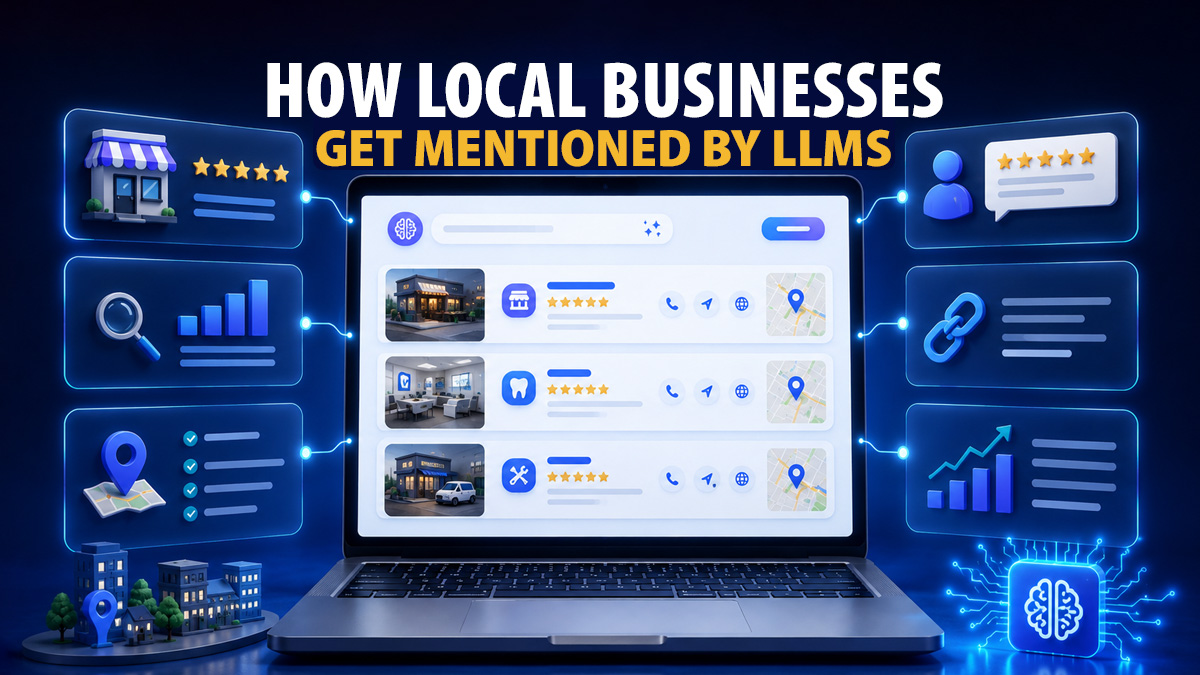
Businesses locally are finding it is not just about ranking on Google but also being recognised by AI’s and LLMs. These systems get data from a vast number of sources: search engines, community forums, structured directories and editorial mentions will all now create a new form of local discoverability for businesses.
Key takeaways:
- AI visibility is necessary for local stores because of the increasing reliance of people searching for local businesses via AI-powered search.
- LLMs ignore “traditional” SEO and rely on entity recognition, looking at data sources such as structured data, citations, reviews, directories and conversations.
- AI trust built on a solid digital footprint, supported by a multitude of sources with positive mention of you: to have it recommended, AI must trust you to do it right.
- Structured Data, Schema and Wikidata entries will be key: it provides AI with an understanding of who you are, what you do and where you are.
- Consistent citations and Google Business Profile optimization are key: AI relies on these for verification.
- Long-tail and conversational content is crucial, AI breaks customer queries into sub-questions: meet those questions with well thought out, natural content.
- Third party mentions carry high authority since press, reviews and forums carry signals AI trusts.
- Continuous optimisation will be necessary, requiring updates and optimisation into the knowledge base.
What is the best way for local businesses to get mentioned by LLMs? If your local business is mentioned by an AI then it could lead to more brand awareness, local leads and an increase in authority. It’s not about manipulating algorithms but it’s about creating a consistent and trusted online presence across multiple channels, by feeding accurate information, and engaging with your local community.
Businesses that understand What is the best way for local businesses to get mentioned by LLMs and how AI uses the signals found in structured data, reviews, citations and content, will be the go-to choice when AI powered search returns recommendations for local queries. Partnering with a local SEO services provider can make it easier to navigate AI and SEO trends.
The End of Blue Links And the Rise of AI Search in 2026
| Signal Type | What LLMs Look For | Why It Matters |
| Structured Data | Schema.org, GBP, Wikidata | Helps AI understand business identity |
| Consistent Citations | Same NAP across directories | Builds trust + verification |
| Brand Mentions | Blogs, forums, news, social media | Core “entity signal” for AI |
| Reviews | Google, Yelp, Trustpilot | Trust + reputation validation |
| Editorial Mentions | PR, news articles, industry sites | High authority credibility |
| Conversational Data | Reddit, Quora, forums | Real-world relevance signal |
For two decades, local SEO focused on Google rankings, map placements, and customer reviews. However, generative AI models currently propel a new type of search.
These tools draw from extensive datasets: online content, directories, organized data, conversational references, and reliable sources. If your company isn’t present in their information, it isn’t there. Here’s the truth:
AI models don’t evaluate websites in the same way as Google. They generate suggestions based on the frequency and confidence with which you are mentioned in structured data, directories, articles, and conversations.
TechCrunch reported, centered on what the company calls the biggest change to the search box in more than 25 years. Instead of returning a simple list of links, Google Search will drop users into AI-powered interactive experiences, starting this week.
What Is The Best Way For Local Businesses To Get Mentioned By Llms In 2026
Mastery of Structured Data
AI systems navigate Schema.org data, Wikidata, and various structured sources. Companies that have comprehensive and precise schema (LocalBusiness, Organization, Product, Service) are more likely to appear.
| Structured Element | Example | AI Impact |
| Schema.org Markup | LocalBusiness, Service schema | Helps AI classify business type |
| Google Business Profile | Name, address, reviews | Core ranking + verification signal |
| Wikidata Entry | Entity knowledge record | Improves AI recognition |
| Directory Listings | Yelp, Apple Maps, TripAdvisor | Reinforces entity consistency |
| NAP Consistency | Same Name/Address/Phone everywhere | Prevents AI confusion |
| FAQ Schema | Question-based structured content | Improves AI answer matching |
Directory Presence + Precision
Traditional directory SEO is more important than it has ever been. Yelp, TripAdvisor, Trustpilot, Google Maps, Apple Maps, Facebook, and specialized directories play a significant role in AI training datasets.
Conversational References
LLMs acquire knowledge through digital discussions, Reddit, Quora, discussion boards, articles, reviews, and blog entries. If no one talks about your business, it’s a phantom.
Citation Authority
Citations from reputable websites, local media, business associations, or industry blogs increase your chances of being “retrieved” in AI answers.
Prompt-Related Context
Should your business description be missing the specific phrases that users search for (“top vegan bakery in Lexington” or “urgent plumber York”), the AI will not establish the connection.
The Updated Local SEO Guide for AI Visibility
To succeed in this AI-driven environment, local businesses need to look past Google.
Phase 1: Basis of Structured Information
Utilize Schema.org markup to indicate precisely what you offer, your location, and the audience you cater to. AI models process this data directly. Without a schema on your site, machines cannot detect you.
Step 2: Add a Wikidata Record
Wikidata supports various AI systems. An accurate and well-organized Wikidata profile for your business serves as a direct visibility tool.
Step 3: Establishing Authority for LLMs
Concentrate on obtaining citations from reliable sources, local news outlets, industry publications, and respected directories. AI models assess authority by considering aggregated signals rather than relying solely on backlinks.
Step 4: Foster Conversational Presence
Inject your business into pertinent online discussions. Forums, Reddit discussions, FAQ sections, and your personal blog all play a role in how AI models understand your identity.
| Source Type | Example | AI Effect |
| News Sites | Local newspapers, TechCrunch | Strong authority boost |
| Forums | Reddit, Quora discussions | Real-user validation |
| Industry Blogs | Niche service blogs | Topic relevance boost |
| Review Platforms | Google Reviews, Yelp | Trust + sentiment signal |
| Business Directories | Yelp, YellowPages, Apple Maps | Entity confirmation |
| Editorial Features | Interviews, PR mentions | Highest credibility signal |
Step 5: Content Fine-Tuned for AI
Your website and business profiles should feature natural-language phrases that align with what users input into AI prompts. Contemplate genuine inquiries, not mechanical keywords:
- “Highly rated cat groomer in Tokyo”
- “Birmingham locksmith available around the clock”
AI Visibility Tools in 2026
The majority of local companies are not ready for this change. Conventional SEO firms do not address it. This is the reason AI visibility tools are being developed to address the need.
Checks if the brand’s name is used in AI responses
AI visibility tools enable brands to track precisely where and how their brand is mentioned in AI outputs. As virtual assistants, chatbots, and AI search engines are becoming the main communication channels, being featured is important for brand awareness.
These tools monitor when mentions appear, the context and manner in which they do, and potential misrepresentation. These data allow companies to fine-tune content and raise their brand visibility and authoritativeness in AI-generated search environments.
- Pinpoints which AI applications and tools are mentioning their brand and thus assess their visibility across the entire AI ecosystem.
- Studies the context and sentiment in which they are mentioned and ensure that the brand is being presented accurately and not with any false or negative associations.
- Identifies missing search queries or AI-generated answers that relate to the brand to highlight opportunities for increased visibility within AI.
- Fine-tunes content, metadata, and structured signals in order to enhance the possibility of the brand’s appearance in highly valuable AI interactions.
Identifies missing structured data, schema errors, and gaps in Wikidata
The accuracy and presentation of information about your brand depends on structured data, schema markup, and knowledge graphs for AI. AI citation tools scan for missing and incorrect schema, incompleteness in Wikidata, and other types of gaps that may hinder AI from understanding and identifying your content correctly.
By fixing these issues, companies can make sure AI knows how to return accurate answers, generate suggestions, or populate information in a knowledge panel. In doing so, brands improve their authoritative stance and appearance in AI-driven results.
- Diagnoses if your website lacks necessary structured data and schema markup to help AI models properly identify content and your services.
- Pinpoints inaccuracies or inconsistencies in your current schema that might be causing AI to misinterpret the nature of your brand, services, and products.
- Understands where your knowledge graph, Wikidata, is missing details and would cause the AI to give an incomplete answer.
- Once corrected, your AI visibility will increase because AI has a comprehensive, accurate set of information to draw from to represent your brand
Detects mentions in AI-generated content and optimize for LLM visibility
Brands need to be able to track how they are being mentioned in AI-generated content and address issues of misrepresentation or underrepresentation. AI visibility tools monitor AI-driven results such as chatbots, virtual assistants, and other outputs for mentions of your brand.
They can identify instances where your brand is incorrectly portrayed and show when your brand should be mentioned but isn’t. This allows brands to identify gaps in AI representation and use targeted content and schema to increase visibility in these areas.
- Monitors AI outputs for where and how your brand is mentioned to discover the current AI brand perception.
- Highlights inaccuracies in the AI’s content, out-of-date information, or misrepresentations that could damage your brand’s perception.
- Reveals where your brand is underrepresented in the content your potential customers are seeing and use that information to find ways to strategically increase mentions.
- You can then use both new content strategies and schema enhancements to ensure your brand appears frequently in these valuable AI interactions.
Also Read: 4 Proven AI Search Optimization Strategies for Winning LLM Citations (2026)
Run ongoing AI SEO to stay visible as models update
Since the AI models are being retrained with new data constantly, AI visibility is always changing. Businesses must adopt a continuous AI SEO approach to ensure their brand’s visibility never falters with every model update.
Monitoring AI visibility consistently and updating content and schemas in relation to the AI model updates eliminates any dramatic changes in business visibility. Consistent messaging can also be maintained through consistent updates to AI and content.
- Tracks changes in how your brand appears to identify drops or increases in visibility as models update their data.
- Ensures the accuracy of your brand’s information by consistently updating content and schema markup for AI to pull from.
- Uses AI trends and algorithm updates as a cue for refining content and SEO strategies to stay relevant.
- Continuous visibility means consistent brand representation over time, ensuring you maintain your authority in AI-driven environments.
Optimizes for AI intent and query understanding
AI visibility tools allow brands to connect their content with AI model processing of user intent and query context. Unlike SEO, traditional SEO focused on keywords; AI search has moved towards semantic meaning, intent and context. Using intent in your content optimization allows you to better connect with your audience using AI.
By identifying questions and topics which trigger an AI response, you can optimize your content to match the user intent as perceived by the AI and dramatically improve your content discoverability and authoritativeness.
- Understands which queries and intents are being returned by AI to identify content gaps and opportunities for optimization.
- Structures and phrase content to better align with the way AI comprehends questions and contextual relationships.
- Implements semantic signals, schema, and FAQs to enhance the probability that AI returns your content.
- Regular content adjustments ensure your brand’s relevant responses are seen by the right audience.
Actionable Tips to Actually Get Cited by AI Engines in 2026
Optimize for long-tail, neighborhood + service queries
Local AI visibility usually does better with specifics than generics. You don’t want to focus on just “electrician near me,” but rather, “emergency laptop repair in Lexington.” The long-tail terms match what the AI uses as the basis for an AI answer and is likely running numerous sub-queries behind the scenes.
When you cater your content for very specific situations you have a higher chance the AI will pick your business out as the most relevant answer, building your authority more organically than with terms anyone could be looking for.
- Create pages where services, neighborhood, and customer issues all come together for highly targeted AI generated searches.
- Structure your content around actual customer situations, not keywords that every competitor is already going for.
- Incorporate local landmarks, service areas, and typical usage situations to improve local query relevance.
- Always look for long-tail opportunities by following search trends, customer inquiries, and AI question generation patterns.
Have an active GBP and consistent citations
Citations and an optimized Google Business Profile are core signals for an AI’s interpretation of your business. By having a consistent NAP across the various directories, review sites, and other local listing platforms you reinforce your entities for the AI.
AI systems will rely on these types of trusted third-party signals as proof your business actually exists and serves a particular geographic location. Activity on your Google Business Profile page also helps with its perception of being a “live” and useful listing to recommend.
- Maintain consistent information throughout the web in terms of NAP across your directories, review sites, social media profiles and your own website.
- Ensure your Google Business Profile is active by posting content and responding to reviews regularly.
- Build citations across all relevant directories, both the big ones and niche specific sites that the AI may consider valid references.
- Monitor your listings for duplicate information or old data, which could lower the trust score an AI gives to your entity.
Make the best of local subreddits, Quora and community forums
The real “opinions” in an area that the AI sees is based heavily on what it can glean from subreddits, Quora and forums dedicated to local topics. Participate naturally in these forums-answering questions, offering advice and giving a natural mention of your business.
By doing so you provide genuine citations that the AI can trust, thus building your own entity’s authority in the area and the likelihood of being cited for the task. Having a presence in multiple forums means you get citations more readily for a single topic from different contexts, adding even more proof.
- Answer genuine questions on the forum and contribute helpfully so you don’t just seem like you’re trying to sell something.
- Build credibility by consistently providing valuable content and you’ll start being perceived as an expert in your niche and locale.
- Listen for recurring questions relevant to your service and provide detailed, personal experience-based answers to them.
- Spread yourself out across several forums so there are numerous trusted references of your business across different channels.
Also Read: Top AI SEO Agencies In 2026: 10 Industry Leaders in LLM Optimization
Editorial mentions and press coverage accelerate AI visibility
One authoritative mention in the right place can make a huge difference in how a business is cited. A third-party editorial citation carries much more weight than a directory or an article written by you or for you. It validates your entity across multiple knowledge graphs including Google’s.
It also helps solidify your own domain authority, and often spreads onto other authoritative sites too; hence the multiple citations for you. This means that getting an article, interview, or any type of feature on a credible website that links back to your business will go very far in ensuring the AI has confidence recommending your entity.
- Aim for a mention on sites that have a strong authority and link back to your business directly.
- The key thing to aim for is mentions where your business and expertise are directly relevant and incorporated into the story, not just a directory-style listing.
- Try to get the press to cover unique things like your company’s involvement in the community, notable client wins, or important company milestones.
- Once an editorial mention is secured, try and promote it widely on your own channels so the information gets repeated as often as possible.
Avoid traffic spikes immediately after launch
An immediate, unnatural spike in traffic is a major red flag for Google and its AI systems. It can immediately put you into a trust vacuum because of the potential for it being a promotion or unnatural source of traffic.
If a brand launches its website with tons of traffic right out of the gate there is potential for trust issues even when the traffic is legit. Gradually launching a site gives AI systems the chance to index it, see traffic coming in over time, build the entity for the business naturally, and begin building trust, along with reviews and citations over time as well.
- Introduce your new business or new marketing campaign slowly and give the search engines and AI time to evaluate you naturally.
- Focus on consistent, sustainable growth rather than rapid traffic surges after launching a new website.
- Build trust and your entity as well as other signals like citations and reviews before driving massive amounts of traffic to your business.
- If a rapid jump in traffic seems suspicious, scale back promotion for a while until it looks more natural.
To Conclude
In order for businesses to achieve a mention by an LLM and AI tools it’s vital to have both credibility and consistency across a number of different levels, and to have visibility on relevant channels.
Businesses that build up authoritative content, with up-to-date and structured data, create trusted citations and gain editorial mentions, are always going to be found by AI systems. It is also essential for businesses to be a trusted part of their local community whether on forums, subreddits, or through reviews.
It will take time, as there is no one magic fix that will yield instant results, but by following the right process, consistent application will create compound effects for AI discovery.
Local businesses will find they are given more visibility by AI by making their information accessible and reliable in a new ecosystem. This also improves authority for the long-term, so when the right answer is sought from AI, your business has already made itself a reliable suggestion.
FAQs
How do LLM’s decide which local businesses to mention?
LLMs use multiple signals to make decisions about local businesses. These signals include structured data, such as the GBP, stable and consistent NAP citations across various directories, customer reviews, editorial mentions, inbound links and the quality and context of online content. A LLM will also check community discussions on forums, subreddits and trusted third-party sources to verify a businesses reputation. If data about a business is consistent, and it is referenced in numerous high-quality locations then an AI will likely give it more trust when citing local results.
Will traditional SEO still be relevant to the way LLM’s mention local businesses?
Yes, traditional SEO is extremely important. Because AI tools use information taken from search engines in order to recommend businesses they will often reference the businesses that have achieved better results organically, or have a strong local SEO presence. Some key factors will include well-optimised GBP’s, a large number of reviews, strong local citations and well-written and optimised content on individual service pages. Essentially, AI leverages search engines and the search engine authority as an additional channel to surface reliable, trusted results.
How will LLMs and AIs handle the problem of contradictory data?
When there are conflicting pieces of data about a local business, AI’s will most likely choose the most credible and consistent sources. If there are inconsistencies in the data of your NAP across different sources and channels then the AI may not mention your business at all, or it will not include a lot of relevant data from all the sources. This is why accurate and consistent NAP data is so important. Most high-quality sources such as a Google Business Profile or reliable online directories will give the AI the confidence that it requires to display your information.
What is the most common mistake businesses make with AI visibility?
A business can make a mistake in that they assume it’s a shortcut and not a long-term strategy. Attempting shortcuts such as overstuffing keywords, buying links or spamming directories simply won’t work with AI systems, and can damage authority long-term. It’s not about finding quick fixes, or gaining shortcuts. It’s about the fundamentals and by having a well-built structure of good structured data, quality content, and credible and reliable mentions/citations a business is much more likely to succeed long-term.
How do AI’s use third party websites to validate a business?
Third party sources give the AI an independent check on the trustworthiness and credibility of your business. This is done through reviews on reputable sites, editorial mentions or mentions in reputable, high-authority directories or websites. The AI’s will see if your business has been referenced on many separate sites and how often and consistently. If there are a lot of trusted, reputable third-party sources mentioning your business then it is much more likely to give the AI the confidence it requires to mention your business.