Being recommended through AI technologies is not an optional thing any longer, it is a reality that every company needs if it wishes to be visible through intelligent technologies. These technologies constantly monitor information online and provide recommendations on the most relevant and credible businesses for users.
Key takeaways:
- AI recommendations have become critical for ensuring that businesses have adequate visibility.
- Manual checks for AI visibility cannot be relied upon since results vary from day to day. Businesses require metrics that can provide accurate visibility scores, and SAIV is one of the data-driven solutions used today.
- Weak, old, and inconsistent data about the company hinder AI in making confident recommendations against other firms with better digital signals.
- The recommendation process includes measuring brand sentiment, so businesses must ensure that they have positive reviews and credible messages.
- Companies should concentrate on the platforms that use AI algorithms to make recommendations rather than trying to spread their presence everywhere.
- These include website content, mentions, reviews, responses to negative reviews, listings, and media mentions.
- Improving your online presence through SEO optimization and structured content creation will increase AI trust in you and help your firm rank highly.
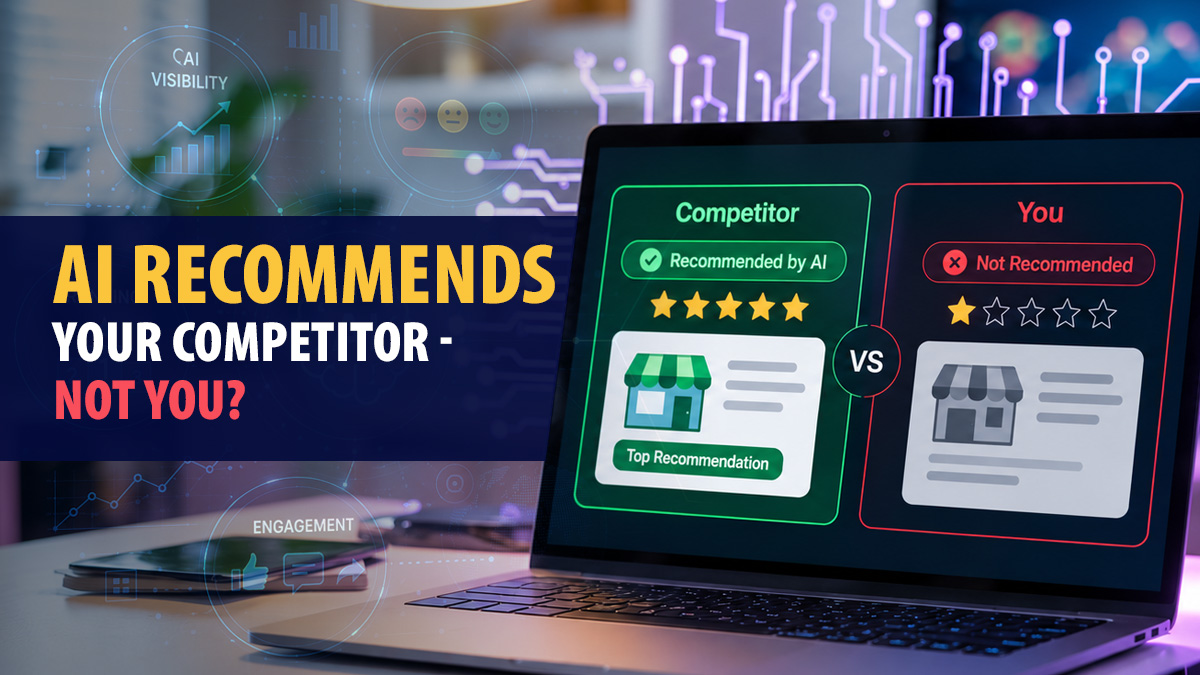
- Competitor Gets Recommended by AI, You Don’t. It is important to monitor your AI visibility, sentiment, ranking, and engagement regularly.
Yet being included in such recommendations does not happen spontaneously, but requires effort on the part of business organizations to optimize their presence and improve relations with customers in a manner favorable for getting recognized.
With a knowledge of how artificial intelligence works to evaluate visibility, sentiment, and authority of a particular entity, businesses can make certain efforts in order to get recommended through AI technologies.
This is achieved by measuring the degree of AI visibility of a company, studying influential sources, controlling brand perception and optimizing content in order to achieve results that are easily perceivable by AI technologies.
Standing out in the era of AI search means giving algorithms the concrete data they need to justify recommending you. Experienced AI SEO services align your content, reviews, and entity signals to ensure your brand becomes the definitive choice top engines put in front of buyers.
Are You Certain You’re Not Suggested by AI?
| Comparison Point | Manual AI Visibility Checks | Share of AI Voice Measurement |
| Accuracy | Low, because results can vary by user, location, time, and prompt | Higher, because it measures visibility across many representative AI queries |
| Scope | Limited to a few searches or prompts | Covers multiple prompts, locations, and customer-intent queries |
| Reliability | Inconsistent and difficult to benchmark | Data-backed and easier to track over time |
| Business Usefulness | May lead to wrong assumptions about AI visibility | Helps identify whether visibility is actually low or simply misunderstood |
| Best Use | Quick spot-checking | Strategic AI visibility tracking and improvement planning |
This may seem like an odd starting point, but it’s crucial to verify that your business isn’t being suggested by AI before taking any action. Numerous business owners initially realize they’re “not in AI”.
They perform some Google searches and review the AI Overviews that pop up, or inquire with ChatGPT, don’t find their business referenced, and determine their AI presence is nonexistent. This is a simple assumption to hold and it is frequently incorrect.
Manual checks are a method with low precision for assessing your visibility in AI outcomes. AI replies tend to be quite diverse by their very nature. An identical search query executed by two distinct individuals in separate locations, or even by one individual in a single location, may yield entirely different results.
Execute it once more in a few minutes or tomorrow, and the outcomes might change again. In reality, AI-generated business suggestions rarely repeat in the same way, so a few manual checks provide limited insight into your true visibility across the entire variety of searches your potential customers conduct daily.
What you truly require is a Share of AI Voice (SAIV) metric, a quantified score indicating the frequency of your brand’s presence in a broad, representative array of AI queries within your market. This converts a subjective observation into a tangible data point you can utilize.
AI tools are designed to deliver precisely this type of measurement. Instead of depending on random inspections, they evaluate your local AI presence throughout:
- An extensive variety of pertinent questions and prompts, as numerous as you wish to observe
- Your complete service region or target audience (various for businesses with multiple locations)
- Tailorable geographic range, spanning from hyperlocal to regional
The outcome is a transparent, data-supported view of how frequently AI is prominently featuring your brand in important spaces. At times, you’ll find that your SAIV is indeed valid, you’re showing up in AI results more than what your manual reviews indicated, and the problem is completely different.
In other cases, the information shows that your AI visibility is indeed low, indicating significant efforts are required. Regardless, you cannot enhance what you cannot assess. Establishing a precise baseline of your AI visibility, or Share of AI Voice, is the first step.
Possible Reasons Why a Competitor Gets Recommended by AI, You Don’t in 2026
| Reason | What It Means | Business Impact |
| Weak brand data | AI cannot find enough reliable information about your business online | Competitors with stronger digital signals are more likely to be recommended |
| Inconsistent listings | Business name, address, phone number, or service details differ across platforms | AI may lose confidence in your business information |
| Low review volume | Few or vague reviews make it harder for AI to understand customer experience | Your business may appear less credible than competitors |
| Poor brand sentiment | AI may mention your business but describe it less positively | Visibility may not convert into leads or customers |
| Limited third-party mentions | Few media mentions, directory references, or industry citations | AI has fewer authority signals to validate your business |
| Outdated website content | Website pages do not clearly explain services, locations, expertise, or value | AI may not understand when or why to recommend your business |
AI Lacks Sufficient Data Regarding Your Brand
If your SAIV data indicates minimal to no AI visibility, the primary root cause is often a sparse or disjointed digital presence. AI acquires knowledge about companies similarly to how search engines operate, by analyzing and interpreting data sourced from the internet.
If there is little information about your brand or if existing content is inconsistent, outdated, or scattered across low-authority sources, AI will lack sufficient data to confidently endorse you. Consider it like this: AI is essentially creating a depiction of your business based on what information the internet provides about you. Data scarcity and poor quality are leading causes of AI failure, with research showing that only 12% of organizations report their data is sufficient for effective AI implementation.
If the internet isn’t providing much information, or the information it provides is vague and unconfirmed, you’ll be ignored in favor of competitors with a digital presence that offers AI more tangible content to analyze. Typical indications that your brand’s signals are insufficient for AI recommendations:
- Limited or no feedback on significant platforms (Google, Yelp, Facebook, niche-specific listings)
- Inconsistent business details across directories, particularly differing name, address, or phone number
- A site with minimal content that fails to clearly outline what you offer, where it occurs, and who your audience is
- Seldom or no references in external articles, community news, or sector publications
- Limited or dormant social media activity
The positive aspect is that this is resolvable, yet it is beneficial to understand where to direct your efforts. Not every platform holds the same significance in AI replies, and that significance fluctuates by industry type, market, and even between different AI platforms.
The Source Information section of AI visibility reports is essential: it reveals the specific platforms and websites that AI references while formulating responses to the queries and prompts you are monitoring.
After identifying the most significant sources for your business and its competitors, you can focus on establishing your presence on those first, instead of diluting your efforts across every available platform.
You Have AI Visibility, But AI Sentiment Lacks Strength
Many business owners are taken aback by this situation: it is entirely feasible to have strong AI presence, to frequently appear in AI-generated answers, yet still fail to generate significant business from AI search. In what way? Due to a significant distinction between being referenced and being endorsed.
Results from local searches generated by AI do more than simply enumerate names. They use particular terminology to outline businesses, and the way AI communicates about your brand directly affects a potential customer’s decision to select you rather than a competitor mentioned alongside you. Think about two potential AI replies:
- “[Business Name] offers various residential services locally, though some customers mention challenges when trying to schedule an appointment.”
- “Clients frequently characterize [Business Name] as remarkably prompt in their responses, with technicians who clarify the issue effectively, avoid unnecessary upselling, and ensure the work area is cleaner than upon arrival.”
Both companies were referenced, but which one are you contacting? The second one not only provides information, it convinces. The language is precise, fosters trust, and strikes an emotional chord that encourages someone to make a choice.
If AI portrays your competitor similarly to the second example while depicting you like the first, you’re losing clients even when you are technically present. This differentiation, between visibility and persuasion, is what AI brand sentiment analysis aims to tackle.
AI visibility Scan Reports consist of two notably strong features for this purpose:
Buyer Persuasion Score (BPS): A numerical indication of how effectively AI is portraying your brand to prospective clients. It successfully assesses the likelihood that AI’s language regarding you will turn a searcher into a true customer.
Brand Phrases: The particular terms and expressions that AI reliably links to your company and the emotions they evoke. This uncovers the story that AI has constructed about your brand, and if that story is benefiting you or subtly hindering you.
Viewing both the Buyer Persuasion Score and the exact language AI employs when referencing your business, along with the sentiment conveyed, provides genuine insight into the disparity between AI’s portrayal of you and that of your top competitors. Such clarity enables you to transform a blurry frustration into a concrete action plan.
Ways To Enhance AI’s Perception of Your Company in 2026
When you comprehend your AI brand sentiment, you gain a guide for enhancement. The language AI employs to discuss your business doesn’t come from thin air, it’s derived from cues scattered throughout your whole digital footprint.
This indicates that your impact on it is greater than you may realize. Here are several important strategies for shaping AI’s statements regarding your company:
Enhance the wording in your reviews. BrightLocal research states 97% of consumers read reviews for local businesses. AI relies significantly on the precise language customers employ when evaluating your business. Vague reviews such as “excellent service, strongly recommend” provide little for AI to analyze. Motivate happy customers to elaborate on their experiences: What issue did you address? In what ways did your team convey data? What caused the experience to be memorable? These details serve as the fundamental components that AI combines to create its portrayals of your brand.
Engage in digital PR to influence external media coverage. Articles, features, and mentions in credible publications hold considerable influence in how AI portrays businesses. If directory listings are the sole third-party content regarding your business, you’re overlooking a significant chance. Actively seek local media exposure, provide expert insights for industry journals, and establish collaborations that create significant, favorable written material about your brand from reputable AI sources.
Update the content on your website and directory listings. The content on your website, the description of your Google Business Profile, and your listings on sites such as Yelp, Tripadvisor, Facebook, and Bing Places are all resources that AI draws from. If the content is sparse, vague, or hasn’t been refreshed in years, this is the moment to revise it using specific, benefit-oriented language that effectively conveys what distinguishes your business as the preferred option.
Be deliberate in your review response. Your responses to reviews are public and may shape how AI views your brand’s personality and customer service beliefs. Careful, detailed answers indicate trustworthiness and true involvement, traits that frequently appear favorably in AI descriptions.
Establish a presence on the platforms that AI genuinely cites. Refer back to the original data from your AI visibility reports and focus your optimization efforts on the platforms that hold significant importance in your sector. Not every directory listing holds the same value.
Also Read: What No One Tells You About Building a Brand in ChatGPT
A Practical Strategy to Get AI to Suggest Your Business
If you’ve made it to this point, you probably find yourself in one of three scenarios:
- You’re uncertain about your actual visibility in AI-driven search and have been forming conclusions based on several manual checks.
- Your AI visibility is indeed quite low, and it is essential to enhance your digital presence so that AI recommends your business with the necessary information to recommend you.
- Your AI visibility is present but lacks strong sentiment, requiring enhancements to the narrative surrounding your brand.
In each instance, the initial step remains consistent: obtain accurate information. You can follow the below steps to create a strong strategy:
| Step | What to Do | Why It Matters |
| Measure current AI visibility | Check whether your business appears in AI assistants, AI Overviews, chatbots, and recommendation engines | Establishes a clear baseline before making improvements |
| Analyze source data | Review directories, websites, reviews, social platforms, and third-party mentions | Helps identify where AI is getting information about your brand |
| Evaluate brand sentiment | Study reviews, customer feedback, social conversations, and AI-generated descriptions | Shows whether AI is portraying your brand positively or negatively |
| Fix visibility gaps | Update website content, business listings, structured data, reviews, and local SEO signals | Gives AI clearer and more trustworthy information to use |
| Track progress regularly | Monitor AI mentions, sentiment, rankings, traffic, and competitor visibility | Helps refine strategy as AI algorithms and competitors change |
Measure Current Visibility in AI Engines
To effectively work on improving recommendations of your business via AI, you have to measure the existing level of visibility first. You should start with checking if your business appears in the results of AI-powered assistants, chatbots, search summaries, and recommendations.
Pay attention to how your business is presented, whether the information provided about your business is correct, and what exactly is mentioned. With such an audit, you will be able to identify any gaps and find areas for improvement to develop your further strategy.
- Check business mentions and visibility on AI platforms, chatbots, search summaries, and recommendation engines
- Analyze how your business is described in terms of products/services, prices, brand positioning, and customer value according to the AI tools’ recommendations
- Pay special attention to visibility for particular keywords used by customers to look for a company/business like yours
- Find out any incorrect, incomplete, or outdated information that prevents AI from recommending your business
Do Source Analysis
AI algorithms create recommendations based on data obtained from websites, review sites, business directories, forums, social networks, and third-party databases. You will have to find out from which sources AI obtains its understanding of your brand in order to optimize recommendations.
Analyze the sources in which information about your business is present online, making sure that it is accurate and consistent everywhere. Any inconsistencies in the business name, outdated contact information, or contradicting information may diminish the degree of trust of AI to your business.
- List all sources where information regarding your business is provided such as websites containing listings, social media accounts, and other web pages
- Ensure that details regarding your business name, address, phone number, website, and services offered are updated and consistent across all these channels
- Identify credible sources of information which will be relied upon by the AI recommendation engine for their recommendations
- Delete any duplicates and contradictory pieces of information that may mislead AI algorithms
Evaluate Your Brand Sentiment
The modern AI recommendation system considers the reputation of the company before making any recommendations. Reviews, feedback, conversations, and mentions of the company online may be used to assess the reputation of your company. The knowledge about whether your company has a positive or negative reputation should not be ignored because it could have an impact on the visibility of the recommendations.
An evaluation of the reputation of your company will enable you to pinpoint areas that require improvement. Improving your reputation and offering more value to customers makes you seem like a credible and reliable company to AI recommendation engines.
- Analyze customer reviews, feedback, comments, and social conversations to gain an insight into what people really think about your business
- Find out which customer compliments, concerns, and experience gaps are regularly mentioned by consumers when discussing your brand
- Measure the evolution of positive and negative sentiment to see if the reputation of your business improves over time
- Actively respond to customer concerns to establish a reputation of trustworthiness and reliability
Narrow Down the Gaps with Targeted Improvements
When you’ve identified the gaps in visibility, source quality, and sentiment, the next thing to do is make necessary improvements. Start by addressing any misinformation, enhancing SEO, increasing customer interactions, and producing content that can be understood by AI systems.
Well-structured content, proper indications of expertise, and good customer reviews increase an AI’s trust in a business. What’s essential here is not just any kind of optimization but precisely fixing the issues that you have identified. Strategic improvements result in better authority indicators and higher chances for your business to get included in AI-recommended results.
- Optimize the content on your website, providing clear explanations about your services, signaling your expertise, and structuring your content properly
- Work on the local SEO and business listing of your website, making sure it appears everywhere and is properly marked up with data
- Make it a priority to encourage satisfied customers to write thorough positive reviews about your business
- Create content that showcases your company as an authoritative source within its field
Also Read: How to Use AI for SEO – 10 Ways That Actually Work
Track Your Process of Improvement
There is constant development in terms of AI visibility due to algorithm changes, better competition, and shifting consumer behaviors. Tracking progress will help determine whether the optimization process leads to an improvement in both recommendation systems and visibility of your company.
You can establish performance indicators such as mentions in AI algorithms, search visibility, review sentiment, and increase in traffic. Tracking performance trends over time can show what works better and what needs adjustment. The companies which constantly track and develop their online AI visibility will certainly be successful in achieving high levels of visibility and authority and beating the competition.
- Monitor how often your business receives mentions in AI-generated recommendations, chatbots, and search summary results
- Measure changes in sentiment, search visibility, engagement rates, website traffic, and other performance parameters after making changes
- Compare AI visibility and online authority to those of your main competitors in order to find areas for improvement
- Optimize AI visibility according to performance data, changes in the algorithm, consumer trends, and recommendations patterns
Wrapping Up
In order to be recommended by AI, it involves a process of preparation, optimization, and management. Having a website and social media account is only half the battle, but what’s important is having accurate, full, and positively reinforced information that makes it easy for an AI system to recommend your business.
Businesses that are able to measure their visibility, track their sentiment, optimize their content, and manage their sources are going to be seen as opportunities and subsequently be recommended by the AI system.
The more you are recommended by the AI, the more aware consumers will be, more reviews will come in, and your overall authority will be solidified. Monitoring your performance will allow you to continue improving yourself in alignment with any changes made in algorithms and customer behavior.
FAQs
How do you assess the visibility of your business in the AI sphere?
Assessing AI visibility means analyzing the presence of the business within AI-powered software, search engines, chatbots, and recommendation platforms. Some important actions to do when assessing AI visibility would be looking at rankings for particular keywords, evaluating the way AI presents the business, and examining the presence in local and industry-specific searches. There are many tools which can be used to track trends, snippets, and mentions to quantify the visibility of a business. Setting up a benchmark in terms of visibility allows one to find weak spots and work on them.
From what sources does AI get its information about businesses?
AI analyzes a variety of sources like business directories, reviews, social media, an official website, or reliable third-party sites. These sources are cross-checked to evaluate credibility and reliability. Some AI-powered tools may also analyze news publications, blogs, community discussion forums to make an opinion about the reputation of the brand. Therefore, the reliability and quality of sources play a key role in the recommendation process.
What role does brand sentiment play in AI recommendations?
As brands become aware of how AI makes recommendations based on online activity, the influence of brand sentiment will only grow. When a business enjoys many positive reviews or mentions from customers, receives high ratings and is actively engaged with users, chances of being recommended by AI rise considerably. The algorithms look for patterns in feedback, frequency of good vs. bad mentions and general engagement level. Effective brand sentiment management through review response, reputation analysis and improvements in customer service increases your chances of AI approval.
How frequently should I monitor my AI recommendation performance?
Algorithms used in AI constantly learn and change in order to reflect users’ preferences better. This means that AI performance will vary over time. Tracking recommendations and visibility once a month or quarterly allows to see whether any changes in ranking are taking place and which ones you should capitalize on. Metrics such as AI mentions, search engine rankings, brand mentions sentiment, traffic growth and engagement rate are among key ones. Comparing AI recommendation performance to competition gives valuable insights.
Is it possible for small businesses to be suggested by AI?
Yes, small businesses can become subject to suggestions by an AI system, usually by making themselves visible through optimization, correct listings, and positive customer sentiment. Correct structured data, clear contact details, and relevant content make a business more discoverable. Generating positive feedback and maintaining credible online reputation makes an AI system trust the business. With limited resources, small businesses can compete with big players to be suggested by AI.