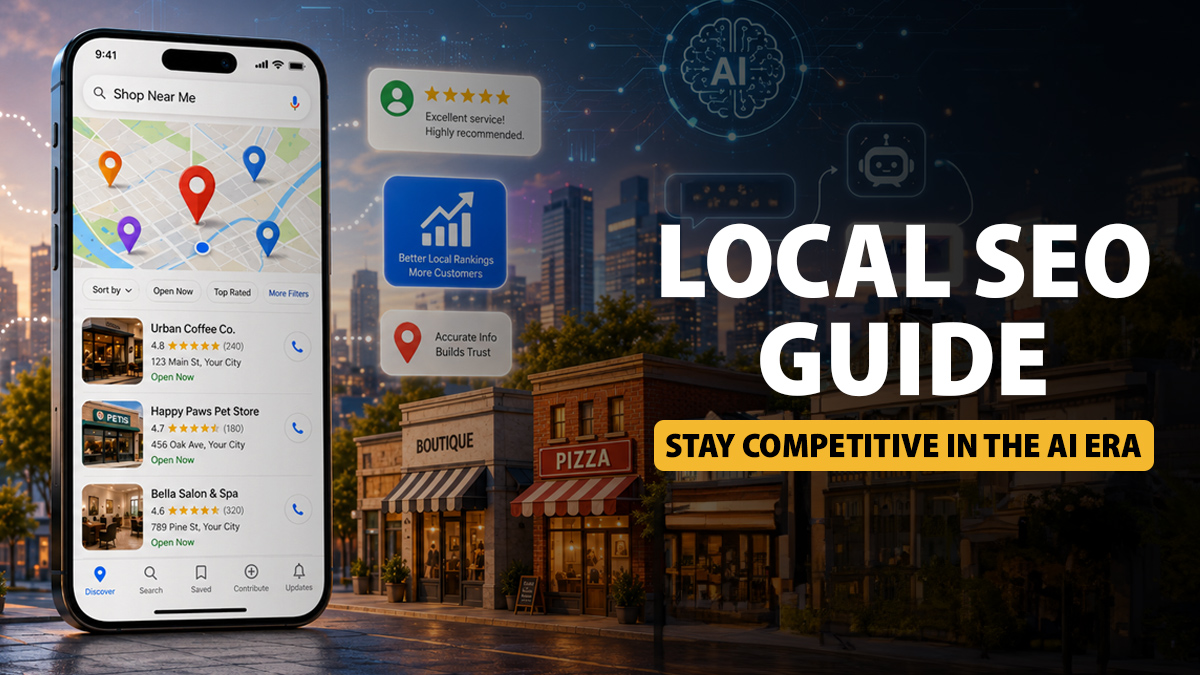
The world of local SEO is undergoing a major transformation because of AI technology which is affecting the process of search in terms of its ability to determine user intent, analyze behavioral trends, understand content value and provide a very personalized experience to every individual who uses it.
Key takeaways:
- Local SEO enables organizations to target customers that are currently looking for services within their geographical location and will be willing to turn into potential customers.
- The importance of local SEO has been further enhanced by mobile searches where people tend to look up for businesses on the go.
- There are mainly three factors that help Google rank your business locally. These include relevance to the search term, proximity to the searcher, and overall prominence of the business on the Internet.
- A properly optimized Google Business listing is probably the most valuable asset that helps improve your ranking in local search results.
- This includes having accurate categories, updated contact information, operational hours, pictures, and consistent listings updates.
- Reviews have an extremely significant impact on local SEO where not only the number of reviews but also their quality makes a big difference in terms of local SEO ranking.
- Local keyword research should take into account how actual customers search.
- NAP consistency on local sites, location pages, and mobile optimization will effectively deliver services and their locations.
- The use of schema markup will assist in structuring business information and improving results in the SERPs for better visibility.
- Directory citation consistency and link building through relevant local sources can increase your credibility and authority within local searches.
- Measuring important statistics such as calls, directions, site traffic, and queries is vital in assessing the success of local SEO efforts.
- Even though the landscape is rapidly changing through the rise of AI, certain fundamentals of Local SEO Guides are still highly important.
Local SEO has become way too complicated than just the simple process of applying location-based keywords and GBP optimization. Among these are voice search, AI suggestions, voice assistants, and automation, just to name a few. With these technologies incorporated in Local SEO, the process becomes even harder.
Nowadays, there is an important urgency among local businesses that require them to change their approach to Local SEO to meet this challenge. It would mean that they must be able to create high-quality content, maintain a good reputation, know the new ranking factors and provide valuable experiences. Local SEO Guides you on how to rank even in the AI era.
With AI transforming how customers search for physical businesses, relying on traditional keywords is no longer enough. Partnering with a dedicated Local SEO service provider ensures your business data is structured perfectly for AI search engines, driving consistent walk-in traffic directly to your front door.
What Is Local SEO and Why Is It Important in 2026?
Table 1: Quick Local SEO Action Plan for 2026
| Local SEO Area | What to Optimize | Why It Matters in 2026 |
| Google Business Profile | Categories, NAP, hours, photos, services, posts, reviews | Helps Google and AI-powered search systems understand and display accurate business information |
| Local Keywords | “Near me” terms, city keywords, neighborhood keywords, service-based searches | Captures users with strong local intent who are ready to call, visit, or book |
| Reviews | Review quantity, quality, freshness, sentiment, and responses | Builds trust and directly supports local visibility and customer decision-making |
| Website Pages | Location pages, mobile optimization, schema markup, clear service details | Gives Google stronger local signals and improves conversions from search traffic |
| Citations & Links | Business directories, local websites, industry listings, chambers of commerce | Strengthens business credibility and confirms NAP consistency across the web |
| Tracking | Calls, direction requests, website clicks, GBP insights, customer source tracking | Helps businesses measure whether local SEO is actually generating leads |
Local SEO will enable you to be found when people around you search for whatever it is that you offer. SEO, basically, refers to the optimization of the visibility of your business through search engines like Google.
Local SEO is different from standard SEO in that it focuses on bringing you local clients as opposed to fighting the entire nation with other companies all around the country.
The Impact of Mobile Search on Local SEO
The transition to mobile search has fundamentally transformed the way local SEO operates. When a person types “Italian cafe” on their mobile, Google uses GPS to determine their precise location and displays restaurants they can reach by walking or driving.
This geolocation information renders mobile searches extremely beneficial for local enterprises. Think about this: 76% of individuals who look for nearby options on their mobile devices go to a business within a day, and they are more inclined to do so if it’s within a five-mile distance.
These are not merely browsers – they are potential buyers with urgent intent, frequently looking up information while they are already out and prepared to buy. Desktop inquiries for nearby businesses occur, yet they typically take place during the research stage. When people are prepared to take action immediately, mobile searches occur.
Consider it like this: when a person types “Italian cafe,” Google displays eateries in their vicinity. However, when they look up “Italian cafe Georgia,” they are quite specific regarding the location, likely planning a visit or exploring another area of the city.
This is where local SEO is essential: ensuring you appear in both general searches conducted by individuals in your vicinity and the targeted location-based queries. We discovered that businesses listed in the Local Pack receive 3.2 times more phone calls compared to those positioned 4-10 in standard search results.
The Three Factors Google Values for Local Rankings in 2026
Google relies on three key signals to determine which businesses appear in local search results. Grasping these concepts is akin to possessing the solution guide for local SEO:
- Relevance
Is your business truly aligned with what the individual is looking for? If a person searches for “dog grooming” and you operate a pet supply store, you won’t appear in the results, even if you offer dog shampoo. Google examines your industry type, the content on your website, and the way you outline your services. - Distance
What is your proximity to the location where the person is looking? You may not alter your location, yet you can be wise regarding your service zones. If you’re an electrician covering 40 miles, ensure Google is aware of it. - Prominence
This is Google’s method for assessing the recognition and trustworthiness of your business. They examine your ratings, the frequency of your business’s online mentions, and if other sites refer back to you.
Consider it your neighborhood reputation rating. Companies that comprehend and enhance for all three of these aspects don’t merely achieve better rankings, they receive more calls, more foot traffic, and more clients.
Also Read: The Ultimate Hyperlocal SEO Guide for Local Businesses
Reasons Many Companies Misunderstand Local SEO in 2026
The error that nearly all individuals commit: they believe local SEO is simply obtaining a Google Business Profile and considering it complete. It’s similar to launching a shop, displaying a simple sign, and anticipating a rush of customers. It could be effective if you’re the sole choice in the area, but there’s a good likelihood that you aren’t.
You’re up against not only nearby companies but also national brands and franchises that possess specialized marketing teams and larger financial resources. Genuine local SEO involves ensuring that all aspects of your online presence function cohesively:
- Your Google Business Profile is finalized and enhanced.
- Your website clearly indicates what you offer and the locations where you provide your services.
- Your business details are uniform across all online platforms.
- You’re consistently gathering feedback and monitoring your reputation.
- Additional regional sites refer to you and provide links.
When all these elements function in unison, a fascinating outcome occurs: you achieve higher rankings not only in one or two search results. You begin appearing for numerous various search phrases connected to your company. At that point, local SEO transitions from merely beneficial to a powerful customer-acquiring tool.
Google Business Profile is Crucial
Your Google Business Profile is the key component of your local SEO plan. It’s more than just another online listing, it’s frequently the first result people encounter when searching for businesses similar to yours, and it significantly affects your visibility in Google’s “Local Pack” (the top 3 business results featuring the map).
Most companies create their profile one time and then ignore it. They complete just the basics, submit an unclear image, and question why competitors receive all the inquiries. What are the key elements that affect being discovered and selected?
Table 2: Google Business Profile Optimization Checklist
| GBP Element | Optimization Tip | Common Mistake to Avoid |
| Business Category | Choose the most accurate primary category and add relevant secondary categories | Selecting a broad or unrelated category |
| Business Name | Use the exact real-world business name | Adding keywords unnaturally to the business name |
| Address & Service Area | Keep the address accurate and define real service areas clearly | Claiming areas the business does not actually serve |
| Phone Number | Use a local number that is answered during business hours | Using call centers or numbers that go unanswered |
| Business Hours | Update regular, holiday, and special hours | Leaving outdated hours visible |
| Photos | Add images of the storefront, team, services, products, and completed work | Uploading only generic or low-quality images |
| Google Posts | Share offers, updates, events, and seasonal announcements regularly | Creating the profile once and never updating it |
| Reviews | Request reviews consistently and reply to all reviews | Only asking happy customers during short review campaigns |
The Basics That Every Business Misunderstands
Your Business Type
This is the key choice you will make for your Google Business Profile. Your main category informs Google about your business type and dictates the searches you qualify for.
Select the category that most accurately represents your primary service. You can include as many as 9 extra categories, but your main category is the most important.
If you work as an electrician, opt for “Electrician” instead of “Contractor.”
If you own an Italian cafe, avoid selecting “Cafe”, opt for “Italian Cafe.” The more precise you are, the higher you’ll rank for related searches.
Your Company’s Name
Utilize precisely what appears on your storefront or legal paperwork. Avoid cramming keywords into your business name – Google will detect this, and it may negatively impact your rankings. If you’re “John’s RO Purifiers,” avoid attempting to be “John’s RO Top Purifiers in Georgia.”
Your Location And Service Region
If you operate a physical site that customers come to, provide that specific address. If you operate a service business that visits clients, you can conceal your address and establish service zones instead.
Clearly indicate the areas you truly serve – if your travels only extend 20 miles from your location, refrain from stating that you cover the whole state.
Your Contact Number
Utilize a local number that is answered by someone during business hours. Google detects when your phone sends every call directly to voicemail.
The Elements That Truly Generate Phone Calls
Operating Hours
Consistently maintain these updates. Nothing irritates prospective clients more than arriving at a business that is closed. Establish special holiday hours, and ensure Google is informed if you close early on specific days.
Images That Convey Your Narrative
Google states that companies featuring photos receive 42% more direction requests and 35% more clicks on their websites. Submit images of:
- Your shop or office space
- Your team at work
- Your items or finished projects
- Satisfied clients (with consent)
- The interior of your place
Google Posts
These resemble social media updates that show up directly on your Google Business Profile. Many companies entirely overlook these, which is an error. Post about:
- Exclusive deals or discounts
- New offerings or solutions
- Future events
- Content from behind the scenes
- Updates by season
Posts become unavailable after 7 days, so you must continually add new ones to remain engaged.
The Evaluation System That Operates Automatically
Reviews serve not only as pleasant social validation, they also play a direct role in ranking. Companies that receive more favorable reviews achieve better rankings in local search outcomes.
The Basic Review Request System:
- Recognize the ideal time (immediately following the successful completion of service)
- Write a script: “We would greatly value it if you could spare 30 seconds to provide us with a review on Google.” “Here’s the direct URL…”
- Simplify the process with a brief URL or QR code that directs users immediately to your review page.
- Send a text or email to follow up if they appeared pleased but didn’t provide one.
Replying to Reviews
Reply to each and every review within 24 hours. For favorable feedback, a straightforward “Thank you for picking us!” is effective. For unfavorable reviews, recognize the concern, offer an apology if suitable, and encourage them to reach out to you directly for a resolution.
The Biggest Error Companies Commit with Reviews
They only inquire of satisfied clients. The truth is: if you solely inquire of individuals who had a positive experience, you’ll receive a lower overall number of reviews. Inquire with everyone (in a professional manner) and concentrate on enhancing your service to ensure that more experiences are favorable.
Your Google Business Profile isn’t a one-time setup that you can ignore later. Companies that manage it as their online shop, ensuring it remains current, lively, and captivating, are the preferred choice for customers.
Identifying the Keywords That Truly Attract Customers
Many companies tackle local keyword research in a completely reversed manner. They focus on what they wish to rank for rather than what their customers are truly searching for. What typically occurs is that a dentist aims to rank for “best dentist,” develops content centered on that term, and then questions why it’s unsuccessful.
In the meantime, individuals in their vicinity are looking for “dentist near Brooklyn,” “ER toothache,” and “teeth cleaning Lexington.” What sets them apart? Those follow-up searches indicate genuine intent from individuals who require dental services immediately.
How Individuals Truly Look for Local Stores?
Local searches can be classified into three primary categories, and it is essential to appear in all of them:
Urgent Requirement Inquiries
“Car repair emergency,” “pharmacist available 24/7,” “electrician currently open.” These individuals require urgent assistance and will contact the first company they discover that can address their issue.
Service and Location Queries
“Hair Salon Georgia,” “Italian cuisine in Queens,” “bike repair Atlanta.” These searchers understand their needs and have a general idea of their desired location.
Conversational Problem-Solving Inquiries
“Where can I have my car repaired today in Georgia?” or “Locate a dentist that accepts my insurance and is taking new patients.” These searches influenced by AI necessitate thorough, in-depth content for accurate matching.
The Easy Method to Discover Your True Keywords
Begin with Google’s Recommendations
Enter your primary service into Google and observe the suggestions it provides. If you own a laptop repair shop in Lexington, begin by typing “laptop repair” and observe the results.
You will receive recommendations such as “Lexington laptop repair,” “local laptop repair,” “urgent laptop repair,” and “reviews for laptop repair.” Record all pertinent recommendations – these originate directly from actual input from individuals.
Examine the “People Also Ask” section and Related Searches
At the end of search results, Google displays “People also ask” questions along with “Related searches.” These are valuable resources for grasping what your customers truly seek to understand. In a laptop repair shop, you may observe:
- “What is the expense involved in repairing a motherboard?”
- “What constitutes an urgent laptop repair?”
- “How can I locate a trustworthy laptop technician?”
Examine the Websites of Your Competitors
Check the sites of companies that have a strong ranking in your vicinity. Which terms do they employ in their page titles, headings, and service explanations? Observe the patterns in their service descriptions instead of directly copying them.
A strategy many companies overlook, review your competitors’ GBPs monthly. Capture their images, updates, and offerings. Observing them introduce new services or modify their strategy frequently suggests they are reacting to customer needs or emerging market possibilities.
The Keywords That Many Local Businesses Overlook
Names of Neighborhoods and Districts
Don’t limit your focus to just your city – aim for particular neighborhoods, districts, and surrounding regions. “Riverside laptop repair,” “Brooklyn Downtown dentist,” “Old Town cafe.”
“Near” Searches
“Laptop service close to ASU,” “café near the airport,” “fitness center near downtown.” Individuals frequently look for companies close to notable sites, educational institutions, or familiar neighborhoods.
Issue-Resolving Inquiries
Rather than simply “laptop repair,” consider “motherboard repair,” “RAM upgrade,” “CPU diagnostic service.” These extended phrases face reduced competition and exhibit greater intent.
Urgent Searches
“Laptop repair available on Sunday,” “emergency vet services 24/7,” “eatery stays open late.” If you provide extended hours or emergency services, ensure that you are focusing on these.
Optimizing Your Website for Local Search in 2026
Your site must inform Google and users precisely what services you offer and where they are available. Many companies believe Google is aware of this, yet search engines require explicit signals to comprehend your location and offerings.
Consider this: Google indexes countless websites daily. If your veterinary website appears just like any other plumbing site, featuring the same generic content and vague location references, how can Google determine that you’re the ideal option for someone in your particular region?
The Location Indicators Google Truly Searches For
Your NAP Everywhere
Your company name, location, and contact number must be consistent across all online platforms. This indicates that your website footer, contact page, GBP, and all directory listings must align perfectly. Avoid using “564 Main St” on one website and “564 Main Street” on another. Choose a single format and adhere to it rigorously.
Pages Tailored to Each Area You Operate In
If you operate in several cities or neighborhoods, develop specific landing pages for each to enhance local SEO performance for all of them. Avoid compiling all the places you serve into a single “service areas” page.
For instance, rather than: “We provide services to Austin, Round Rock, Cedar Park, and Georgetown”. Generate individual pages:
- “Laptop Repair Services in Austin, TX”
- “Round Rock Emergency Laptop Repair”
- “Cedar Park Laptop Repair”
Every page must feature distinct content regarding that particular region – local attractions, services unique to the neighborhood, or area-related details.
Instead of merely listing your services, describe how they address particular issues relevant to your location.
Rather than a standard service page, develop specific pages for every location you cover, featuring original content that tackles local issues: Example URL Format:
- yourbusiness.com/plumbing/texas
- yourbusiness.com/plumbing/georgia
- yourbusiness.com/plumbing/charlotte
What Needs to Vary on Each Location Page:
Local issue recognition: “Texas’ extreme summer temperatures and regular storms create distinct pressure on your plumbing. Our group recognizes the unique difficulties that homeowners in Texas encounter…
Location-specific services: Include hurricane readiness, hail damage restoration, or other local requirements.
Local landmarks for context: “Assisting homeowners from Downtown Texas to the Energy Corridor”
Pricing tailored to the neighborhood: “We recognize the financial concerns in the Texas area and provide adaptable financing options.”
Community reviews: Highlight feedback specifically from that region.
Response times in the area: “Emergency response within 20 minutes across Greater Texas.”
Schema Markup
Schema markup is code you include on your site that assists Google in comprehending your business details. It’s akin to providing Google with a summary of your identity and activities.
Have you ever observed that certain businesses in Google search results present detailed information such as hours, ratings, and location right in the results? That’s LocalBusiness schema markup in action, the underlying code that alters how your business is displayed in local search outcomes.
The Importance of Schema Markup for Local Businesses
Adding LocalBusiness schema markup to your website effectively assists Google’s algorithms. Rather than Google needing to speculate about your business hours or your location, you are clearly defining this information. The advantages are considerable:
For Google: Complete information regarding your business specifics.
For customers: Quick access to hours, location, and services without additional clicks.
For your company: Differentiate from competitors with compelling, interactive search outcomes.
The Fundamental Requirements Google Has
- The name of your business
- Your full business address
- Your phone number including the country code
- Hours of operation and business schedule
- The specific type of your business
Fast Implementation Choices:
WordPress: Utilize plugins such as Yoast Local SEO or RankMath Pro.
Other platforms: Insert the JSON-LD code into the head section of your website.
Automated option: Utilize Localo’s FREE LocalBusiness schema generator for dynamic, self-refreshing markup.
Here’s a simple illustration of how LocalBusiness schema appears:
<script type=”application/ld+json”>
{
“@context”: “https://schema.org”,
“@type”: “LocalBusiness”,
“name”: “Your Business Name”,
“address”: {
“@type”: “PostalAddress”,
“streetAddress”: “546 Main Street”,
“addressLocality”: “Lexington”,
“addressRegion”: “TX”,
“postalCode”: “42681”,
“addressCountry”: “US”
},
“telephone”: “+1-153-658-0513”,
“url”: “https://yourbusiness.com”
}
</script>
This gives Google an exact idea of your location, timings, and contact details. You need to make sure that all this data matches your Google My Business account.
The Web Content That Truly Converts
To create website content that attracts local visitors, you must comprehend the unique aspects of your area and how your services address local challenges. Generic content that may suit any business anywhere will not rival content that addresses local issues, community engagement, and specific neighborhood requirements.
Participation in Local Community
Take part in, be involved with, and ultimately spotlight your involvement with community activities, charities that you support, or any other local organizations that you are associated with. This will help you gain tremendous local relevance and visibility and get organic backlinks through other local websites.
Customer Experiences from Your Region
Rather than using generic testimonials, incorporate specific narratives that feature local elements and generate content based on those. Here’s an effective method: Transform an authentic customer experience into content that is specific to a location.
Rather than simply saying “Excellent service!”, develop a comprehensive case study.
Reasons this is effective for local SEO:
- It refers to a particular area
- It contains timely information that residents can connect with
- It shows the response time for your service area
- It generates material related to “emergency laptop repair Lexington” and comparable queries
- It demonstrates that you comprehend the needs of local customers
Mobile Optimization Matters
57% of local searches occur on mobile devices (Google). If your website isn’t functioning flawlessly on mobile devices, you’re losing clients to rivals who are.
Key Mobile Components:
- Your phone number needs to be clickable, allowing people to call with a single tap.
- Your location should connect to maps or directions.
- Contact forms ought to be straightforward and feature large buttons.
- Loading time for the page is less than 3 seconds.
- Text that is easy to read without needing to zoom in.
Establishing Local Authority via Citations and Links
Citations and local links are the ways Google assesses whether your business is credible and well-established within your community. Consider them as online citations – the greater the number of quality references you have from reputable local sources, the more Google believes that you are a legitimate, established business deserving of visibility to searchers.
What Citations Truly Are?
A citation refers to any online reference to your business name, address, and phone number. It doesn’t have to reference your website to be considered a citation.
Google relies on citations to confirm the existence of your business and its stated location.
When your business details are consistently displayed across numerous reputable websites, Google becomes more assured of your legitimacy. Citations Show Up On:
- Business listings (Google Business Profile, Yelp, Yellow Pages)
- Regional websites (business associations, community news platforms)
- Profiles on social media (Facebook, LinkedIn company pages)
- Evaluation platforms (sector assessment websites)
- Websites of the government (business permit directories)
What Causes Citations to Function?
Prior to creating citations anywhere, you must ensure these basics are correct. These minor specifics distinguish citations that enhance your rankings from those that perplex Google:
NAP Consistency Matters Most
Your company name, location, and contact number need to be consistent across all online platforms. Even small variations can impact your local rankings. Instances of how consistency appears:
Consistent ones:
Company name: “Lexington Laptop Service” (across all platforms)
Location: “456 Main Street, Suite 450” (in all instances)
Phone: “(123) 654-0583” (in all locations)
Inconsistent ones:
Business names differ: “Lexington Laptop Repair,” “Lexington Laptop Repair LLC,” and “Lexington Laptop Shop.”
Address formats vary: “456 Main St” vs “456 Main Street” vs “456 Main Street, Suite 450”
Formats for phone numbers vary: “(123) 654-0583” vs “123-654-0583” vs “123.654.0583”
Select Your Format Once and Adhere to It Devoutly
Choose your specific format for the business name, address, and phone number, and apply it consistently across all platforms. Compile a document containing your precise NAP details and refer to it each time you establish a new listing.
Reasons for Its Significance:
When Google detects your business listed with somewhat varying details on different websites, it raises uncertainty about which information is accurate. Reliable data from over 20 credible websites indicates to Google that you are a recognized and credible business.
The Effective Citation Method That Works
Step 1: Ensure your primary citations are accurate
Begin with these key platforms from which the majority of other directories obtain their information:
- Google My Business (most crucial)
- Apple Maps (for iPhone users)
- Página de Negocios de Facebook
- Yelp
- Bing Business Listings
Step 2: Maintain your information consistent across all platforms
Your company name, location, and contact number must be consistent on all platforms. Even minor variations such as “Street” compared to “St” can perplex Google’s algorithm.
Step 3: Target directories specific to your industry
A listing in a pertinent industry directory holds greater significance than in general business directories.
- Contractors: Angi, HomeGuide
- Dining Establishments: OpenTable, TripAdvisor
- Healthcare: Healthgrades, WebMD
- Legal: Avvo, FindLaw
Step 4: Establish authentic connections within the community
The most significant local backlinks and media exposure arise from genuine community engagement:
- Support or participate in community activities (Little League, charity races)
- Become a member of your local chamber of commerce.
- Join local business groups.
- Develop material addressing local issues unique to your region.
What to Avoid with Citations?
- Avoid purchasing bulk citations from services offering “100 citations for $99” – they are often of poor quality and may negatively impact your rankings.
- Avoid using conflicting information; even minor discrepancies can cause uncertainty in Google’s algorithm.
- Avoid overlooking duplicate listings; having several listings for the same business creates confusion for both Google and clients.
- Avoid using fraudulent addresses – Google verifies various data sources and will detect this.
Citations are fundamental to achieving success in local SEO, but constructing them properly demands a methodical strategy. For a thorough step-by-step guide on reviewing your current citations, discovering new opportunities, and employing tools to streamline the process, refer to a good citation building guide.
The guide should include sophisticated tactics such as leveraging data aggregators, enhancing for voice search, applying schema markup, and assessing your citation effectiveness, everything essential for establishing local authority acknowledged and rewarded by Google.
Reviews: Your Most Influential Ranking Element and Reputation Enhancer in 2026
Reviews play a vital role in local search rankings and influence customer decision making. However, many companies handle reviews incorrectly, they either overlook them altogether, request them at inappropriate moments, or give inadequate responses upon receiving them.
Google not only tallies your reviews but also examines them. The algorithm considers review velocity (frequency of receipt), recency (timeframe of the reviews), sentiment (content of the feedback), response patterns (approach to replies), and authenticity indicators (genuineness of reviews).
This implies that your approach to obtaining reviews must be significantly more advanced than simply “requesting feedback from satisfied customers.”
Comprehending Google’s Review Algorithm
Review Consistency and Velocity
Google anticipates that established companies will consistently receive reviews. A restaurant receiving 20 reviews in one month and then none for the next three months appears questionable. Regular review activity, whether it’s 2-3 each month, indicates a vibrant, credible business.
Review Freshness and Recency
Newer reviews hold greater significance than older ones. A company that has 100 reviews from 2019 will have a lower ranking than another that has 50 reviews from the last six months.
Review Content and Sentiment Evaluation
Google’s natural language processing examines the actual content people write, rather than only star ratings. Reviews that highlight particular services and incorporate local specifics hold more significance than general “excellent service” reviews.
Engagement and Response Patterns
Companies that address reviews, particularly the negative ones, indicate to Google that they are proactively maintaining their reputation and value customer input.
The Methodical Strategy for Gaining Authentic Reviews
Find Your Best Review Times
The optimal moment to request a review is when customer satisfaction is highest:
Restaurants: After the meal (QR code on receipt)
Service companies: Within 24 hours of finishing the job
Retail: Right after buying or once they’ve utilized the product
Healthcare: Following a positive treatment result
Services offered: Upon reaching a certain milestone
Establish Various Contact Points for Review Inquiries
Avoid depending on just one review request:
Face-to-face approach: Educate your team to directly request feedback from happy customers.
Email follow-up: Dispatch a request for a review 24-48 hours post service.
Text message: An uncomplicated text message containing a direct link to your review page.
Simplify the Procedure
The simpler you make it to submit a review, the greater the number of reviews you’ll receive:
- Generate a concise, catchy URL that leads straight to your Google review page.
- Employ QR codes that clients can scan using their mobile devices.
- Add direct links in emails instead of just saying “please review us on Google.”
- Clearly outline the procedure: “It requires 30 seconds and significantly benefits our small business.”
The Strategy for Responding to Reviews That Cultivates Trust
Your reaction to reviews greatly affects your search rankings and your image with potential clients.
Replying to Favorable Reviews
Don’t merely express gratitude; leverage positive reviews to emphasize your value proposition: Instead of just saying, “Appreciate the fantastic feedback!”, you can say,
“Thanks for selecting our Lexington site for your laptop repair emergency!” We’re pleased our same-day service assisted in getting you back on your work promptly. We value customers like you who make the effort to share their experiences.”
Managing Negative Feedback with Professionalism
Negative reviews are not merely concerns for reputation management; they represent SEO opportunities if addressed properly. Google and prospective clients evaluate businesses more on their problem-solving abilities than on the absence of issues.
The structure for addressing unfavorable feedback:
- Respond to the problem promptly (ideally within 24 hours)
- Express regret for their experience (regardless of whether you agree with their issue)
- Assume accountability without offering excuses
- Propose to address the problem by outlining specific actions to take next
- Encourage them to reach out to you personally to carry on the discussion in private
Avoid reacting defensively or providing justifications – view negative feedback as chances to showcase outstanding customer service in a public manner. Instead of just saying, “We regret that your experience was not satisfactory”, you can say,
“Hello John, I appreciate you taking the time to provide your thoughts regarding your latest experience at our downtown site. I truly regret that your dining experience fell short of our usual standards, particularly concerning the wait time and the temperature of the food.
This is not the level of customer service that we aspire to provide, and I am fully accountable. It would be great if we could find some solution to this problem, so you should feel free to contact me at (143) 654-0583 or via email to [email], and we will try to make sure you have an even better experience next time around.”
Instead of replying, “Apologies for the trouble”, you can say,
“Hello Victor, I appreciate you expressing your worries regarding your recent laptop repair situation. I’m sorry our discussion regarding the timeline wasn’t clear, leading to frustration in an already stressful situation.
You are completely correct that we should have updated you more effectively during the entire process. I want to talk directly about how we can correct this and prevent it from occurring with future customers. Kindly reach out to me at (444) 157-5327 so we can address this right away. We are also introducing a new system for customer communication to avoid similar problems.”
Tactics for Advanced Negative Reviews
Transform critics into supporters
When you effectively address a negative review, customers frequently revise their review or post a new positive one. The public resolution showcases your dedication to customer service for potential clients.
Through promptness and professionalism, you convey your accountability and empathy to the customer. You can convert a frustrated customer into a loyal supporter through this type of response.
Leverage unfavorable reviews for competitive benefit
Respond to criticism faster and more professionally than your competitors. While potential customers look into firms, you will differentiate yourself from your competitors because your responses are going to be courteous in nature.
Proactively tackle frequent problems
For example, if there are repetitive complaints within bad reviews (“difficult to find parking” and “wait times are long”), include something similar to “Free parking is available at the back of our building,” or “Feel free to contact us to ask about our wait times.”
The Strategy for Restoring Reputation
In the event that you get an unjust or harmful review:
- Take required screenshots
- Reply professionally by utilizing your typical framework (avoid becoming defensive)
- Report obviously fake reviews using Google’s reporting system
- Create 3-5 favorable reviews to lessen the effect of the negative one
- Utilize genuine complaints to enhance your service
This reply reflects professionalism to potential clients while indicating to Google that you are proactively handling customer interactions.
Optimize Your Review Management
The task of dealing with reviews on different platforms might consume much of your time. With the help of review management tools, it becomes easy for you to manage, respond to, and analyze reviews on one central platform.
The Review Error That Destroys Local Rankings
Mostly, what firms fail to understand about the process of reviews is that this isn’t a single-shot marketing approach; it’s an ongoing method. These companies would do a review drive for thirty days, generate some reviews, and call it quits there.
Google’s algorithm detects this trend and might lower the value of reviews that arrive in unnatural surges. Furthermore, the rate of review generation declines, and rivals with steady review production will ultimately surpass you in rankings.
Successful companies incorporate review requests into their standard operating processes. Each satisfied customer encounter involves an organic request for input. Every finished service features a follow-up inquiring about their experience.
Reviews go beyond local SEO rankings; they focus on creating a lasting framework for customer feedback, managing reputation, and enhancing business performance. Companies that recognize this link view reviews as a competitive edge rather than merely another marketing obligation.
Determining the Effectiveness of Local SEO Strategies
The majority of individuals are unaware if their local SEO strategies are effective. They may observe an increase in calls during certain weeks, yet they remain unaware of what is truly influencing the outcomes.
The positive aspect is that monitoring local SEO performance doesn’t involve complex spreadsheets or costly software. You simply have to observe the correct figures.
Also Read: How Much Does Local SEO Cost In 2026: Full Pricing Guide
The Basic Figures That Reveal the Truth
These three figures provide all the information you require regarding your local SEO performance:
Calls from Google
For many local businesses, this is the key number. When a person discovers you on Google and makes a call, that indicates local SEO is effective.
Your Google Business Profile reveals precisely how many individuals contacted you after discovering your business on Google. Monitor this each month – if it’s increasing, your local SEO is effective.
Directions to your store
When a person selects “Get Directions” on your Google Business Profile, they intend to come see you. This is the closest you can come to assured foot traffic.
Visitors to your site from local search results
Not everyone reaches out right away – some prefer to explore your website first, look at your prices, or learn more about your offerings.
Table 3: Local SEO Metrics Businesses Should Track
| Metric | Where to Track It | What It Shows |
| Calls from Google | Google Business Profile Insights | How many searchers are directly contacting the business |
| Direction Requests | Google Business Profile Insights | How many users intend to visit the physical location |
| Website Clicks | Google Business Profile and Google Analytics | How many users want more information before converting |
| Local Organic Traffic | Google Analytics | How much traffic comes from local search queries |
| Review Growth | Google Business Profile and review platforms | Whether the business is building trust consistently |
| Keyword Visibility | Local rank tracking tools or manual checks | Whether the business appears for important service and location terms |
| Customer Source | Intake forms, phone calls, or CRM notes | Which channels are actually bringing new customers |
Where to Locate These Figures?
Google Business Profile Dashboard
Access your Google Business Profile and select “Insights.” You will observe:
- How many individuals checked your profile this month?
- How many individuals contacted you?
- How many individuals requested directions?
- What is the number of individuals who accessed your website?
Review this monthly and record the figures. Are they increasing or decreasing in comparison to last month?
Google Analytics (for Site Traffic)
To monitor visitors arriving at your website through local searches, you will require Google Analytics. After configuration, check the “Acquisition” report to find out the sources of your website traffic. Important aspects to observe:
- Visitors from “google / organic” (individuals who discovered you via Google search)
- Guests from queries that contain your city name or “in my vicinity”
- Duration on your contact page (shows genuine interest)
Inquire with New Clients
The easiest way to track is to inquire with new customers about how they discovered you
Indicators That Something Is Amiss
Profile views are decreasing: Competitors may be gaining more visibility, or your profile may require enhancements.
People visit your profile but fail to engage: Your profile could be lacking, images of low quality, or feedback deterring potential users.
Website traffic without inquiries: Your site fails to turn visitors into buyers.
The 5-Minute Monthly Review
Establish a monthly alert to review:
Google Business Profile Analytics: Track your profile visits, phone calls, and navigation requests.
New customer origins: Consider how your recent clients discovered you.
Record these figures in an easy location. You seek patterns over time, not flawless information. The aim isn’t to turn into a data analyst. It’s important to recognize when everything runs smoothly and identify issues early on to resolve them before they negatively impact your business.
What to Expect Next in Local SEO and How to Get Ready in 2026?
Local SEO is rapidly evolving since Google is utilizing AI in its search results. Even though AI-powered tools are transforming the way people search for information online, their impact on the world of local businesses has been less profound than anticipated.
As of March 2025, Google’s AI Overviews are present in 13.14% of all queries, yet local businesses aren’t experiencing a similar degree of impact. Studies indicate that AI Overviews have started to emerge for just 0.14% of local keywords as of March 2025.
This indicates that local SEO is not facing the same level of disruption as different sectors. However, that doesn’t imply you should completely disregard AI.
How AI overviews Truly Influence Local Search?
When AI Overviews are present for local queries, they function distinctly from standard searches. Local queries produce a summary of places appropriate for AI Mode inquiries. These summaries seem to be produced by external websites, like Yelp.
A carousel is also displayed beneath the summarized results, which appear to be driven by Google Business Profiles. This is positive information: your Google Business Profile remains highly significant, and reliable local directories such as Yelp are being prominently displayed in AI-generated local outcomes.
Implications for Your Company
The fundamentals of local SEO do not change. Google keeps collecting the data about the local businesses through the channels that you optimize now: your Google My Business listing, credible directories, and local websites.
The AI Readiness That Truly Counts for Local Stores
Ensure Your Data Is Unshakeable Everywhere
AI uses information sourced from different places to formulate summaries. In the event that your business hours are not the same on Google, Yelp, and your business’s site, you might get incorrect information through AI.
Concentrate on In-Depth, Useful Information
Google wants to show relevant content. Work on providing unique and non-commodity content that would be considered relevant and valuable for the Search users as well as your own audience. That means that you should produce content that would completely satisfy the needs of your clients, not just use keywords.
Reinforce Quality of Reviews
As AI Overviews for local searches frequently draw from sources such as Yelp, it is crucial to have comprehensive, genuine reviews available on various platforms. Reviews that reference particular services and local information will aid AI systems in comprehending precisely what your business provides.
The Larger Perspective: Conventional Rankings Remain Relevant
Recent studies show an important finding: if you hold the top position on Google, you have a 25% likelihood of showing up in AI search outcomes. Reduced rankings lead to diminished opportunities. This trend is consistent across all leading AI platforms.
What Does This Signify?
Your current local SEO initiatives are not losing relevance – they are becoming increasingly vital. The companies that perform strongly in conventional local search are also the ones highlighted in AI-generated outcomes.
Key Takeaway for Local Stores
Don’t forsake established local SEO strategies in pursuit of AI enhancement. Rather, perform the basics with excellence: thoroughly fill out GBPs, maintain consistent citations, gather genuine reviews, and create valuable local content.
The same factors that influence conventional local rankings are precisely what AI systems utilize to decide which businesses to include in their summaries.
Prepared to Excel in Local SEO?
You now possess the full blueprint to excel in local search within your market. Achieving success in local SEO relies on three factors: consistency, authenticity, and systematic implementation.
The companies that succeed in the long run don’t merely apply these strategies once, they create systems that preserve their local leadership consistently every month.
Local SEO Checklist
Here are the key components that produce outcomes:
Fundamentals of Google Business Profile
- Select the most precise main category for your business.
- Ensure your NAP remains consistent across all online platforms.
- Reply to every review within 24 hours.
- Regularly share new content and images.
Fundamentals of Website Enhancement
- Develop pages tailored to specific locations for each area you cover.
- Ensure your website is mobile-optimized with tappable phone numbers.
- Naturally incorporate your city name into page titles and content.
- Apply LocalBusiness schema markup
Establish Local Authority
- Register in prominent directories (Google, Yelp, Facebook, Apple Maps)
- Concentrate on directories that are specific to your industry and pertinent to your business.
- Ensure uniform business details across every platform.
- Obtain authentic feedback by consistently following up with customers.
Monitor What is Important
- Observe calls and inquiries for directions from Google Business Profile.
- Inquire about how new clients discovered your services.
- Implement straightforward monthly evaluations to identify patterns.
The stores that excel in local SEO don’t attempt to tackle everything simultaneously. They concentrate on the basics, apply them consistently, and establish lasting systems that create customers month after month.
Your Upcoming Steps
- Start with the Quick Start Summary if you haven’t started with the basics yet (optimization of the Google Business Profile, first ten reviews, NAP consistency, and local website signals).
- Optimize your Google Business Profile – Complete all details, upload high-quality pictures, and set up a review generation strategy.
- Build local authority – Stress citation consistency and get real reviews on different platforms.
- Create a system to monitor progress (calls for questions, directions requests, and local search traffic to your website).
- Develop a plan to perform monthly reviews of the Google Business Profile and local search presence.
Challenges in Local SEO in the Age of AI
Greater Competition with the Use of AI-Generated Content
With the use of AI technology, local businesses find it more difficult than ever before to compete in the world of online marketing and branding, mainly because AI allows firms to create large amounts of keyword-rich content, as well as optimized local landing pages and FAQs.
Smaller companies may not be able to keep up with both the speed and quality of AI-generated content. What is even harder, apart from competing with the amount of content, is finding a voice different from algorithmic content generators. This poses another challenge to smaller local businesses.
- Overwhelm caused by AI-generated material is another reason for small enterprises not being able to gain traction.
- It will be harder to compete because of the fast-paced and efficient nature of AI-generated content.
- The task of keeping a unique tone becomes difficult.
- Enterprises will have to master balancing creativity along with automation.
Voice Search Optimization Difficulty
Voice search has changed the whole way that people carry out local SEO using voice assistants provided by companies such as Google Assistant, Siri, and Alexa. People are no longer finding products or services through a search engine; rather, they are searching using natural speech.
Traditional SEO tactics like keyword loading or static meta tags cannot work in the present era. If you want to succeed in voice search optimization, then it is crucial that you keep your frequently asked questions updated and employ structured data for answering queries through content.
- Voice searches are natural and contextual, meaning the use of natural questions in the content is more important than keyword use.
- Data and FAQs need to be optimized in order to increase the likelihood of being used as a voice answer.
- The constant improvements in AI voice assistants mean that optimization is a continuous process.
- Businesses failing to optimize for voice searches risk losing out on their local customers who are ready to convert.
The Dependence on Artificial Intelligence-Fueled Local Pack Algorithms
More and more, the Google Local Packs and Maps rankings are based on AI algorithms analyzing numerous ranking signals, such as engagement metrics, distance from a user, sentiment in reviews, etc. SEO ranking is used to focus primarily on high-quality content and backlinks.
AI-fueled algorithms place much greater value on dynamic data analysis in real time. This means that the rankings may change dramatically and without any warning, and businesses cannot always predict or influence them. It calls for constant monitoring and optimization efforts, even though they tend to be resource-heavy.
- Algorithms powered by AI examine complicated signals such as engagement, reviews, and behavioral patterns.
- The ranking system may change in unpredictable ways, thus making it tough for businesses to stay consistently visible.
- Optimization based on AI necessitates continual monitoring, tests, and changes; something which small businesses find hard to do.
- It is important for businesses to know and capitalize on these ever-changing signals.
Local SEO Review Management in an AI World
The role of review management in local SEO is also changing with the advent of artificial intelligence technology. Search engines are no longer counting how many reviews there are; instead, they examine their sentiment and their authenticity and relevance to the subject.
Consequently, fake and spam reviews can easily be caught and punished, but at the same time, producing relevant, good-quality reviews is necessary for ranking purposes. Businesses will have to employ strategic actions to encourage real reviews and manage their reputation effectively.
- AI technology analyzes sentiments and relevance of reviews and therefore bad quality reviews can negatively affect search rankings.
- Manipulated reviews are easily identified; hence traditional tactics that have been employed in the past are now ineffective.
- The importance of generating positive reviews cannot be undermined as fake reviews are being easily identified.
- A good response strategy is important for enhancing ranking on local search results.
Challenges with Hyper-Personalization and Privacy
The use of AI makes it possible for local businesses to offer very personalized results when doing searches, keeping in mind different elements like the location of the individual, his or her search history, and even preferences. The challenge posed by this type of marketing is that it can be hard to predict SEO efficiency.
Businesses might get fragmented and inconsistent visibility because users receive different search results. Furthermore, privacy policies also present limitations to the use of AI since businesses can no longer freely gather information about users to personalize results even further.
- The results obtained from an AI algorithm will be personalized to the behavior, location, and preferences of each user.
- Fragile visibility will make it hard for companies to gauge the performance of their SEO efforts in the local market.
- Privacy laws restrict the collection and utilization of personal data for the purposes of AI personalization.
- It is critical that companies strike a balance between personalization, regulatory compliance, and visibility.
Wrapping Up
The emergence of artificial intelligence in search engine development is changing the rules of the game and posing new challenges in the field of local SEO. The role of classical optimization tactics has not been diminished, yet they alone are not enough anymore.
Machine-learning-based search engines prioritize sites that are more relevant to the user’s intentions and engagement rates, authority, and other elements. Therefore, businesses have to concentrate both on technical optimization and on producing quality content, managing reputation, and improving users’ experiences.
The tough competition in the online world, adapting to voice search, constant updates of algorithms, dealing with reviews, and addressing individual needs of customers have to be among their top priorities in such circumstances. The ones that can cope with those challenges and apply AI successfully will surely get paid off for their efforts.
FAQs
Why is voice search important to local SEO in the era of AI?
Voice search will soon become popular due to the use of the voice recognition system by the AI assistants for processing searches done through voice recognition. The searches will no longer depend on keywords but will be done via natural languages. Companies need to make sure that their websites have content optimized for natural languages and long tail keywords.
What impact do AI-driven local packs have on small businesses?
AI-driven local packs are influenced by a range of factors such as location, user engagement, and reviews. Therefore, local packs are much harder to predict and rank in. Even small changes in reviews or search patterns might affect visibility. Businesses need to have optimized profiles and encourage users to leave authentic reviews. They should also ensure their content is consistent and of high quality. What is even more important is that visibility and ranking of local businesses today relies not only on keywords but on numerous other factors analyzed by AI technology.
Will the answers generated through AI make people stop clicking on the links of local businesses?
The search experiences are gradually moving towards becoming an answer experience in which AI generates the information required by the searcher without making them click on any link. For the local stores, this may mean that search engines will be summarizing all their business information, reviews, timings, and services on the search result page. In order to attract customers to the local websites, it becomes essential for businesses to work towards making sure that they optimize their profile and create unique content for users to engage with.
How can businesses find the right balance between automation and authenticity?
AI technology can help local businesses with several issues like making content, SEO optimization, communicating with customers, analyzing data, and more in today’s world. However, when used extensively, reliance on AI technology may make local businesses generic. This is because local businesses have made a mark in this competitive industry by connecting themselves with their communities and serving customers on a personal level. It is therefore good for local businesses to maintain a balance between AI and human input.
What are the impacts of AI in the context of local competitor analysis?
The difficulty involved in doing competitor analysis increases with the use of AI, which customizes the order of search results depending on the user. Even when two individuals search for the same local service, the order in which businesses appear in their searches may differ. This means that rank tracking alone cannot be used to gauge the success of an online business. There is a need for monitoring other aspects such as visibility, interactions, and engagement levels among others.