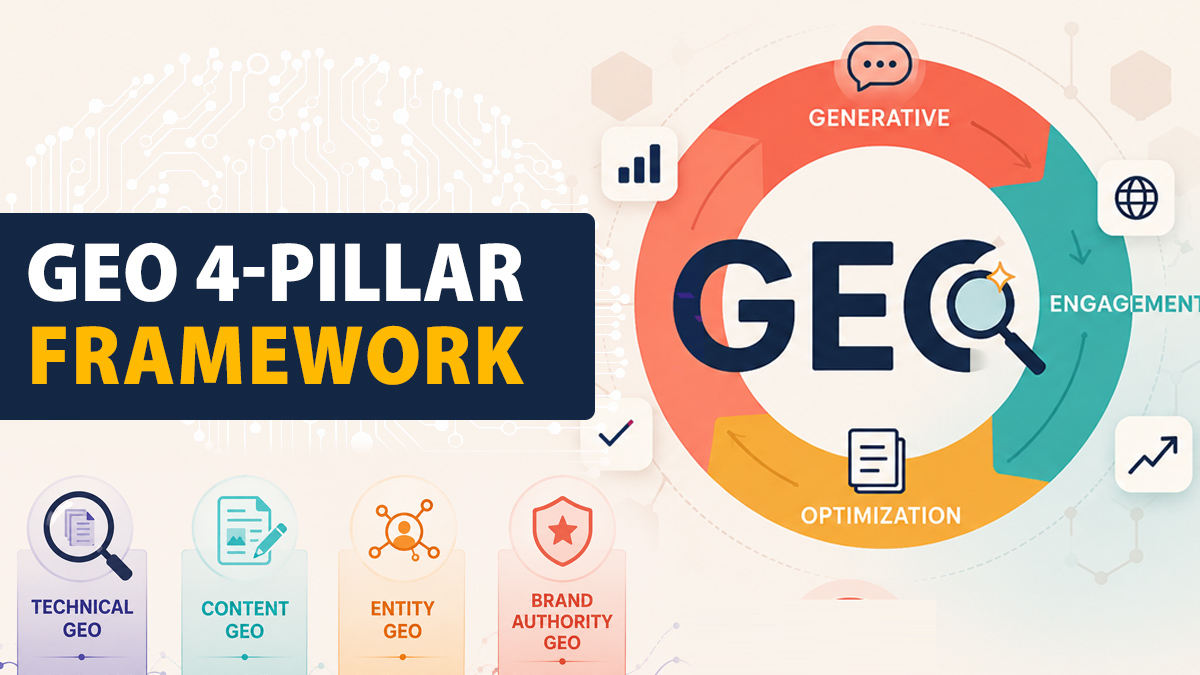
As AI becomes the way people find information businesses need to think about how they make and organize their content. The old ways of doing SEO focus on using the keywords and links but AI search is different. It is about understanding what people mean, what they want and what is relevant.
Key takeaways:
- Generative Engine Optimization emphasizes the optimization of content to facilitate its discovery, understanding, summarization, and recommendation by AI algorithms.
- GEO is a derivative approach to conventional SEO which involves switching attention from keyword optimization and linking to semantics, intent, relevance, and structuring of data.
- The AI search visibility of a website depends significantly on how easily accessible, understandable, and machine-readable the content is.
- The implementation of GEO increases visibility within AI-based answers by providing relevant content that is readily available to be cited, summed up, and recommended.
- The four key pillars on which GEO is based are Technical GEO, Content GEO, Entity GEO, and Brand Authority GEO.
- Technical and content optimization guarantees that AI will be able to access and properly interpret your website, whereas entity and brand optimization build recognition and authority.
- GEO gives your website an additional competitive advantage by improving the chances of citation, summarization, and recommendation in the AI-generated search answers.
Generative Engine Optimization is a way of doing things that helps with this change. It makes sure that AI systems can find, summarize and recommend the content that businesses create. To do this GEO uses organized content and predictions to help AI search visibility understand what is important.
By making content that works with AI businesses can get more people to see their information reach new people and become more well known online. This is because AI is playing a role in how people search for things. To make a GEO strategy businesses need to try new things and understand how AI systems work.
Ready to future-proof your digital presence for the era of AI-driven search? We provide GEO services that implement a comprehensive framework that keeps your business ahead of the competition.
| Factor | Traditional SEO | AI Search Visibility (GEO Era) |
| Primary Goal | Rank on Google results pages | Get cited/recommended in AI answers |
| Discovery Method | User clicks search results | AI generates direct answers |
| Ranking Logic | Keywords, backlinks, authority | Context, trust, structured data |
| Content Style | SEO-optimized pages | Conversational + semantic content |
| User Journey | Search → Click → Browse | Ask → Instant answer |
| Key Platforms | Google, Bing | ChatGPT, Gemini, Copilot |
| Success Metric | Traffic & rankings | Mentions & AI recommendations |
GEO Framework for AI Search Visibility in 2026
Currently, the concept of “online brand visibility” has been significantly transformed by the extensive use of AI platforms by consumers. Conventional SEO continues to be crucial, and robust SEO fundamentals directly enhance AI search effectiveness.
However, succeeding in this newly enhanced AI search environment necessitates Generative Engine Optimization (GEO), a field dedicated to ensuring your brand becomes a resource that AI accesses, comprehends, trusts, chooses, references, and endorses.
GEO is not a substitute for your current organic search strategy; it enhances it to include the AI environment that now exists alongside conventional search engines. The objective remains the same for marketing teams; they continue to seek to place their brand before the appropriate audience, in the correct location, at the optimal time.
What has shifted is that “the right place” is now more frequently found within an AI-generated response. To enhance your brand’s online presence, it’s not sufficient to meet a basic keyword search; you must also address AI reasoning by treating your content as a beneficial resource for people and an organized dataset for machines.
Why GEO-Targeting Matters in AI Search?
Increases Visibility in AI Results
Google AI Overviews Now Reach 2 Billion Monthly Users. GEO-targeting is important for AI Search because it helps people find what they are looking for. GEO makes sure that content is easy for AI systems to find and like. These AI systems make summaries, give recommendations or respond to questions. They like content that’s good, easy to understand and relevant.
Traditional SEO only looks for keywords. AI engines like content that is well made and easy to understand. When businesses optimize for AI-driven search they can be seen by people. By making content that AI systems can understand, businesses can stay ahead. More and more people are using AI to get accurate information.
- AI systems, like content that’s easy to understand and relevant. This means that the content is more likely to be seen by people
- When content is optimized for AI it can reach people who use AI or traditional search engines
- When content is made for AI it helps people get the answers to their questions which makes people happy
- Good content can be found for a time even when AI algorithms change. GEO-Targeting helps with this and makes sure that content is always easy to find
Also Read: How to Rank in ChatGPT for “Near Me” Queries in 2026
Gets Higher Engagement
The content that is made better for GEO is in line with how AI search visibility is impacted. It understands what people want and the situation they are in. When AI shows people your content when they ask for something they get relevant answers that are easy to understand which makes them want to interact more.
This leads to more people clicking spending time on the page and looking at related content. The strategies for making content that works with where people are from or GEO make sure that the content is in line with what AI says making a circle where people using the content shows AI that it is good which makes it more visible and makes the brand more well known.
- Content that is made better by AI is more in line with what people want so they are more likely to use it and trust the information
- When people get structured answers they are more likely to look at other content on your website or platform
- Content that is made better by AI makes people think the brand is more trustworthy and knowledgeable because they use it to get information
- When people use the content more it sends signals to AI systems, which like content that people use in a meaningful way
Strengthens Competitive Position
Using GEO gives you an edge over companies that only focus on traditional search engine optimization. Companies that make content better for AI are more likely to show up in content, summaries or quotes and reach people who do not use traditional search.
By looking at what AI says, finding gaps in content and making a plan to fix them, companies can be seen where their competitors are not. This gives them an advantage in being the first to use AI search and makes their brand a trusted source, in new and emerging artificial intelligence environments.
- Being featured in computer-generated outputs puts your content ahead of competitors who’re not prepared for search powered by artificial intelligence
- When you fill content gaps that computers highlight your business can dominate areas that competitors miss
- Content that is optimized drives traffic from computer recommendations, which increases your reach and potential sales
- Consistent visibility in computer outputs strengthens your brand recognition which makes your business a leader in your field
Supports Content Strategies That Scale With Business
A GEO plan offers a framework for creating scalable content that works well across different computer-driven platforms. Under how AI search visibility is impacted by organizing your content using cues that engines understand.
This plan also helps marketers prioritize topics that computers think are important and that people are likely to search for. This approach ensures that your content keeps performing which maximizes your return on investment and positions your brand to succeed as computers become a primary way people search for information.
- Content that is well-structured and friendly to computers stays relevant even as computer algorithms change, which reduces the need for updates
- Focusing on topics based on what computers think is important helps teams create content efficiently without sacrificing quality
- Organizing content semantically and using metadata improve computer comprehension, which increases the chances of representation, in outputs
- A good content plan enables your content to perform across multiple computer-driven platforms, which expands your reach and long-term visibility
Four Pillar Strategy Framework of GEO in 2026
To improve the organization of your AI brand visibility strategy, we have created a 4-pillar GEO/AEO framework. This allows you to categorize your GEO initiatives into crucial areas that enhance the chances of AI platforms to:
- Locate your content
- Have faith in your content
- Choose your content
- Refer to and cite your brand in replies
Consider this framework as your guide for becoming the primary resource AI systems depend on for producing their responses.
| GEO Pillar | Focus | Funnel Phase |
| Technical GEO | Are AI bots capable of locating and retrieving your content? | AI Exploration |
| Content GEO | Is AI capable of comprehending and retrieving your content? | AI Comprehension & Inclusion |
| Entity GEO | Is AI aware of your identity? | AI Comprehension |
| Brand Authority GEO | Does AI have confidence in and favor your brand? | AI Inclusion |
The GEO Pipeline
The 4-pillar framework aligns directly with what we refer to as the GEO Pipeline, the three phases AI search visibility traverse when determining if your brand should be part of a generated response:
AI Exploration: Are AI bots capable of locating your content? Problems to verify consist of restricted AI bots in robots.txt, and rendering complications.
AI Comprehension: Are AI bots able to accurately understand your material? Areas to examine consist of absent titles and H1 tags, insufficient content, and lack of structured data.
AI Inclusion: Will AI bots opt to reference your material? Factors to evaluate consist of semantic relevance, E-E-A-T indicators, current AI bot interaction, and brand credibility.
Enhancing across all four pillars entails optimizing for all three phases of this funnel.
Also Read: Generative Engine Optimization (GEO) Cost Breakdown In 2026
Pillar 1: Technical GEO
What Does Technical GEO Mean?
Tech GEO focuses on enabling AI bots to locate, access, and comprehend your content while ensuring that your website is readable by AI systems. This technical aspect of AI search optimization serves as the foundation enabling your Content, Entity, and Brand Authority GEO strategies to operate.
If AI is unable to access or comprehend the main source of information regarding your brand, your site, it is likely that your brand will not be entirely or correctly recognized or referenced by AI. Technical GEO impacts four essential results:
AI Discoverability: The speed at which AI and search engine bots identify new and revised content on your brand’s website.
Freshness of Content: Assisting AI in obtaining the latest versions of your information and statistics.
Eligibility for Citation: Determining if your content is technically suitable for inclusion in generated responses.
AI Renderability: The ability of your pages to display properly when accessed by AI systems, essential for AI to interpret your content as you intended.
Checklist for Technical GEO
- Ensure that your site’s robots.txt file does not block AI bots (GPTBot, PerplexityBot, Google-Extended, BingBot, CCBot)
- Confirm that robots.txt and nosnippet directives are not obstructing AI attribution
- Resolve 4xx / 5xx issues to ensure AI bots can reach pages
- Keep enhancing indexability, since numerous AI tools continue to depend on conventional search engine indices to find information
- Utilize schema to enhance the machine readability of your website content
- Ensure robust internal linking within topic clusters
- Make certain that essential content is accessible in raw HTML rather than solely presented through JavaScript
Pillar 2: Content GEO
What Does Content GEO Refer To?
Content GEO guarantees that your content is structured for comprehension by humans and optimized for AI discovery, evaluation, and selection. It emphasizes delivering precise, logically organized, semantically meaningful, and thorough content that AI systems can reliably extract, summarize, and reference.
If technical GEO assesses the accessibility of your content to AI bots, content GEO affects the evaluation of that content’s usefulness, trustworthiness, and likelihood of being selected.
While traditional SEO content focused on fulfilling keyword searches, content GEO emphasizes addressing AI reasoning, guaranteeing that your brand’s insights, explanations, and expertise serve as the foundation LLMs depend on for generating responses.
In the realm of AI-driven search, your content gains an additional function within your overall marketing strategy: it serves as educational input for the models that will define the future of online searching. Effects of content GEO:
AI Extractability: The simplicity with which AI can obtain direct, factual information from your pages.
Preference of Citation: The likelihood of AI choosing your content as the trusted reference instead of a rival’s for a specific query.
Topical Connection: The degree to which AI reliably links your brand with knowledge in a particular field.
Query Fan-Out Completeness: Assessing if your content comprehensively addresses a topic to adequately meet multi-part or subsequent inquiries.
Checklist for Content GEO
- Create straightforward, factual, response-first content that directly responds to user inquiries
- Enhance for semantic pertinence and comprehensive inclusion of associated subtopics
- Create content based on evidence, including references and sources
- Organize content into easily accessible “chunks” featuring distinct H2/H3 headings
- Maintain clarity of entities in content segments, refrain from using pronouns to substitute important entities
- Generate diverse content and include transcripts and informative alt text
- Showcase E-E-A-T via skilled authorship, unique data, and clear sourcing
Pillar 3: Entity GEO
What Does Entity GEO Mean?
Entity GEO aims to guarantee that your brand is distinctly recognized as a unique, identifiable entity by AI systems.
AI platforms need to comprehend your identity, whether it’s an organization, product, or individual, before determining if they can trust or reference your brand, along with how that entity connects to particular subjects, industries, and other entities.
In AI-enhanced search settings, visibility relies more on entity-level comprehension than merely keyword significance in a solitary content piece. Consider it like this:
Entity GEO responds: “What is your identity?”
Brand Authority GEO responds: “Can we put our trust in you?”
Both are necessary for consistent inclusion in AI-generated replies, but Entity GEO must be prioritized. Without it, Brand Authority GEO lacks any basis for connection.
Effective Entity GEO establishes a uniform and precise identity for your brand online, featuring consistent brand descriptions across various platforms, structured data, inclusion in reputable third-party databases and knowledge graphs, and content that distinctly associates your brand with the subjects you wish to be recognized for.
Checklist for Entity GEO
- Maintain uniform and precise brand descriptions across various platforms (website, social media, external databases, media coverage)
- Implement entity-building schema on your site (Organization, Product, Person schema)
- Ensure your brand is featured in reputable third-party databases and platforms (Wikipedia, G2, industry directories, etc.)
- Establish topical authority via content to develop a distinct connection between your brand and significant subjects within your field
Pillar 4: Brand Authority GEO
What is Brand Authority GEO?
Brand Authority GEO revolves around reliability, confidence, and choice. After AI identifies your brand as an entity, it must determine if your entity is worthy of being included, referenced, or suggested in generative replies. This pillar assists AI in responding to more complex inquiries, including:
- Is this organization trustworthy?
- Is this entity held in high regard in its area of expertise?
- Do other reliable sources confirm this entity?
- Would referencing this brand enhance the quality of the response?
Brand Authority GEO affects AI’s trust in your produced content, the likelihood of your brand being chosen over rivals, the visibility of your brand in AI responses, and the nature of those references.
In conventional SEO, an entire sub-industry emerged focused on obtaining backlinks. In GEO, brand mentions that lack a dofollow link can still contribute to positioning your brand as a credible and authoritative presence.
This indicates that digital PR is experiencing a revival, authoritative brand references from reliable sources outside your own site are gaining significance once more.
Checklist for Brand Authority GEO
Digital PR: Obtain both linked and unlinked mentions of the brand from industry publications
Expert Mentions: Obtain citations or interviews from recognized, credible experts in your field
Favorable Brand Perception: Proactively oversee feedback on important external platforms (Google, G2, sector review websites)
Industry Awards: Join pertinent industry associations and achieve esteemed industry accolades
Sponsorships & Collaborations: Team up with reputable organizations to link your brand with strong credibility indicators
Challenges in Creating a GEO Strategy in 2026
| Challenge Area | What It Means | Impact on AI Visibility |
| Rapid AI Algorithm Changes | AI models update frequently | Rankings/visibility can shift unpredictably |
| Content Structuring Complexity | Need semantic + structured formatting | Poor structure reduces AI understanding |
| Measuring GEO ROI | Limited direct analytics | Hard to track AI-driven traffic impact |
| Resource & Skill Gaps | Requires SEO + AI expertise | Slower or inconsistent optimization |
Rapidly Changing AI Algorithms
One of the problems with creating a GEO strategy is keeping up with the fast changes in AI algorithms. Generative engines update their models a lot, change how they rank things and modify how they understand questions and context which makes it hard to keep optimization strategies working over time.
What works today might not work tomorrow so you have to watch and adjust. Businesses need to study how AI works, try things and change their content strategies to stay visible and relevant. Since AI is always changing you need to be able to adapt and think ahead when creating content making GEO an ongoing process.
- AI models get updated all the time so optimization strategies can become news quickly and you have to keep adjusting
- When AI gets features or understands things differently it can change how content is ranked or recommended, which is confusing for marketers
- You have to keep watching and testing how content is doing to keep up with the changing algorithms
- Companies have to spend time and money to understand how AI is changing and adjust their strategies
Complexity of Structuring the Content
Making content work for generative engines is not just about adding keywords. You have to organize it, make sure it makes sense and give enough context so the AI can understand what it means. Unlike search engines, AI looks at content to see what you mean, how ideas are related and how clearly you present things.
People who make content have to balance making it easy for humans to read and making it easy for AI to understand using things, like markup, metadata and formats that AI likes to improve how easily people can find it. This is complicated and often requires knowledge and a new way of planning, and reviewing content to get good results.
- Content needs to be set up in a way that artificial intelligence can understand what it is about
- If the content is not organized well the artificial intelligence systems that generate content may not be able to find it even if it is really good
- Have to find a balance between making it easy for humans to read and making it easy for AI to understand
- It takes time to learn about things like markup and metadata and how to make content that AI systems can use but it is necessary to be successful
Measuring ROI and Performance
It is hard to measure how well a GEO strategy for getting content into intelligence systems is working because these systems do not always give clear numbers or direct feedback. The content may show up in lists or recommendations that the AI systems make.
It may not lead to people clicking on it or visiting the website so the usual ways of measuring success are not enough. Organizations have to use ways to measure success like tracking what the artificial intelligence systems are doing, analyzing how users are interacting with the content and trying out different things to see what works.
- Traditional analytics tools usually do not do a job of capturing traffic that is driven by AI
- Content might be shown in AI summaries or recommendations without people clicking on it
- Organizations have to come up with their ways to track how visible their content is in AI and how it is doing in terms of engagement and conversions
- To figure out the ROI we have to put together data from sources and try out different strategies
Knowledge and Resource Gaps
To do GEO strategies well organizations need a combination of skills and a lot of time and money to invest. Many organizations do not have teams that know about AI behavior, how to structure content in a way that makes sense and how to optimize for engines.
To stay current with the changing trends in AI teams have to keep learning, trying new things and working together across content, marketing and technical teams. If organizations do not have the resources they might not apply GEO strategies consistently. This can lead to performance and not being competitive.
- To be good at GEO organizations need people who’re skilled and understand AI algorithms, how to make content better and what is relevant in a semantic sense
- Have to keep trying things to make sure your strategies are in line with changes to AI models
- If you do not have the experts inside the organization you might not apply the best practices of GEO consistently across our content
- Organizations have to invest in training, tools and working together across teams to really use the potential of GEO
To Conclude
A good GEO framework helps businesses to do well in AI-powered search environments through making their content discoverable, relevant, and credible. Unlike conventional SEO, which only deals with keywords, GEO focuses on intent, context, and clarity.
This way, you help AI search engines find your content for its intended audiences at the best time possible. There are, however, challenges like changing algorithms, content structuring, and performance evaluation involved in implementing the strategy.
It requires continuous monitoring of the behavior of AI engines, and adopting strategies that work with generative engines’ logic. The GEO approach is not a one-off activity but a process that combines creation, optimization, and analysis into one. With its effective execution, brands can be able to create a presence in the AI search world.
FAQs
Which kind of content works better for GEO?
GEO works best for content that is question-based, provides information, or solves user problems. Such content includes articles, guides, FAQs, and explainer content. AI engines prefer well-formatted, semantic, and contextually rich content. Technical guides, product descriptions, and thought-leadership content may also appear in AI results provided they are optimized properly. Any content designed to be referenced, summarized, or recommended by AI can greatly benefit from GEO because such content has more chances of being picked up and highlighted.
What are the main things to consider when it comes to a GEO strategy?
A good GEO strategy needs to have content that’s easy to understand. The people who make this strategy have to think about what users are looking for and make content that computers can read easily. Things like metadata and headings and links to parts of the website help computers understand what the content is about. A good GEO strategy is also part of a plan to market the content so the AI can give users good information that is consistent with what the brand is, about and what it says. This way the users get information and the brand looks good.
Does GEO replace the SEO that we are used to?
No, GEO does not replace SEO. It actually helps SEO. Traditional SEO is still very important for people to see our website on search engines. It is also important for getting links from websites and for our website to be seen as a good website. GEO is different. It is used for search channels that use intelligence. It looks at what people’re trying to do when they search for something and it makes sure the information is clear and easy to understand. When we use SEO and GEO together they work well.
What skills should an individual have for implementing GEO?
In order to successfully implement GEO, it takes knowledge of how AI behaves, structure of contents, and semantic optimization. The teams require skills in creating rich content, managing metadata, and proper format for AI. Also, analytical skills are needed to analyze the outputs of the AI and its performance. It may take collaboration from content creators, marketers, and technical people to make sure that the contents are readable for both humans and AI. The companies may even choose to continuously learn on how the models behave and on generative search trends.
How will organizations future-proof their GEO framework?
For an organization to be able to future-proof its GEO framework, several measures must be taken into account. The key elements that the organization needs to consider include adaptability, learning and structuring of content. Content needs to be created in such a way that it is AI-friendly. This means that semantic markup is essential. It is important for the organization to keep track of any developments in AI platforms. In addition, by integrating GEO with SEO and diversifying content, organizations are able to create resilience.